
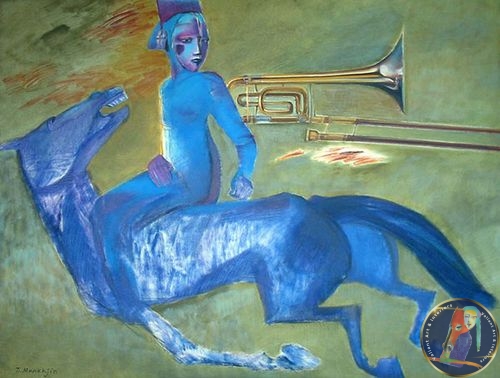
Blue Horse Women is a captivating example of Munkhjin Tsultem’s ability to fuse traditional Mongolian motifs with the bold, expressive techniques he refined during his studies at the Stroganoff Institute in Moscow. Measuring a substantial 111.5 x 145 cm, the painting is a large-scale exploration of form, color, and cultural identity.
Composition and Subject Matter
The painting depicts a group of women intertwined with the figures of horses, rendered in a style that leans heavily into Figurative Modernism. Rather than a literal scene of riders, Tsultem uses a rhythmic, overlapping composition where the silhouettes of the women and the powerful anatomy of the horses become almost inseparable.
The Women: They are portrayed with a sense of quiet strength and timelessness. Their forms are stylized, often sharing the same fluid lines as the animals they accompany, suggesting a deep, symbiotic relationship between the Mongolian people and their equine companions.
The Horses: Painted in striking shades of lapis and cobalt blue, the horses are not merely livestock but spiritual symbols. The use of blue elevates the subject matter, referencing the “Eternal Blue Sky” (Tenger) which is central to Mongolian cosmology.
Color Palette and Texture
Tsultem’s palette is dominated by a sophisticated contrast:
Cool Tones: Deep blues and ethereal teals define the horses, creating a dreamlike, nocturnal, or perhaps spiritual atmosphere.
Warm Accents: Earthy ochres, muted reds, and skin tones provide a grounding counterpoint to the vibrant blues, highlighting the human element within the frame.
Brushwork: The application of oil paint is deliberate and textured. One can see the influence of his Russian academic training in the confident structural rendering of the figures, yet there is a contemporary “looseness” that allows colors to bleed and blend, giving the piece a sense of movement.
Style and Context
As a leading figure in Mongolian Contemporary Art, Tsultem moves away from the rigid Socialist Realism of the mid-20th century. Blue Horse Women represents a shift toward:
Symbolic Figuration: Where the subject matter is recognizable but filtered through a personal, poetic lens.
Cultural Synthesis: Merging the nomadic heritage of Ulaanbaatar with the avant-garde sensibilities of European art history.
In this work, the horse is a vehicle for emotion and national pride, reimagined through a modern aesthetic that feels both ancient and remarkably fresh.