
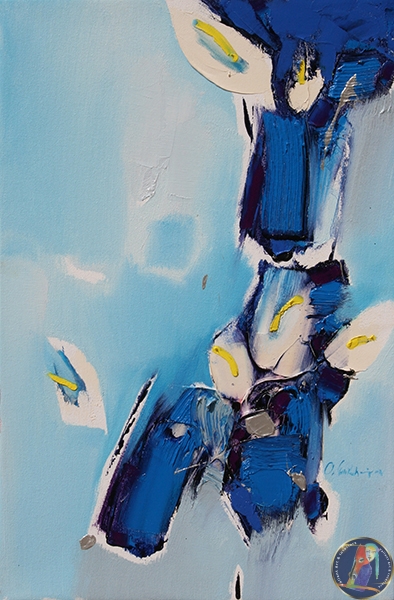
Blue Composition 2 is a sophisticated exploration of texture and tonality, characteristic of Enkhtaivan Ochirbat’s unique fusion of Abstract Modernism and Contemporary Figurative Landscape. The piece serves as a contemplative study of the Mongolian horizon, stripped of its literal details and reimagined through a lens of emotional expressionism.
Composition and Color Palette
The painting is dominated by a rich, multi-layered spectrum of blues, ranging from deep, oceanic indigos at the base to ethereal, atmospheric azures toward the upper register.
Atmospheric Depth: The composition is bisected by a soft, horizontal suggestion of a horizon line, creating a sense of vast, open space reminiscent of the Mongolian steppe under twilight or a heavy mist.
Color Harmony: Ochirbat employs a monochromatic foundation, but punctuates the blue field with subtle shifts in temperature—incorporating cool slate greys and occasional hints of warmer violet undertones to provide rhythmic depth.
Technique and Texture
Reflecting his background in the Art Institute and his years as a teacher at the “Industry and Art” school, Ochirbat demonstrates masterful control over the medium:
Scumbled Surfaces: The artist uses a combination of broad, gestural brushstrokes and finer, scumbled layers. This creates a tactile surface where the underlying colors peek through, suggesting movement like wind or shifting light.
Expressionist Influence: The application of the oil paint is not flat; it carries the weight of the “Action” exhibition series (2002–2004) in which he participated. The visible texture adds a physical presence to the abstract forms, making the “void” of the blue space feel dense and intentional.
Artistic Intent and Context
Created during a prolific period in 2009, this work represents Ochirbat’s transition from traditional figurative representation to a more spiritual, abstract language. By focusing on “Composition” rather than a literal subject, the artist invites the viewer to experience the vastness and solitude of his homeland through color alone.
The painting captures the essence of a landscape without the need for landmarks, distilling the Mongolian environment into a singular, meditative experience of light and shadow.