
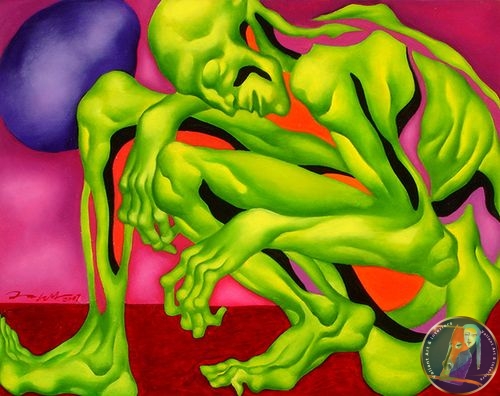
“Black Egg” is a compelling oil-on-canvas work by the Mongolian artist Enkhjargal Tsagaandari. Measuring 45 x 60 cm, this piece is a prime example of Tsagaandari’s ability to weave together the stark, traditional imagery of his homeland with a sophisticated modern sensibility.
Visual Description
The painting is dominated by a central, evocative form: a dark, oval shape reminiscent of an egg, set against a backdrop that suggests a vast, perhaps primordial, landscape. True to the artist’s roots in Ulaanbaatar and his experience with monumental art, the composition feels larger than its physical dimensions, possessing a heavy, grounded energy.
The Subject: The “egg” is not a flat black, but a rich tapestry of deep tones. Tsagaandari utilizes his mastery of oil to create a surface that appears both solid and translucent. The dark orb sits as a focal point, symbolizing potential, origin, or perhaps a silent, cosmic mystery held within the Mongolian wilderness.
Style and Technique: The work bridges the gap between Abstract and Figurative. While the egg is a recognizable form, the surrounding environment dissolves into expressive, textured brushwork typical of Contemporary Landscape painting. The artist’s background as a teacher and monumental artist is evident in the confident, structured application of paint.
Color Palette: The palette is likely rooted in earth tones—ochres, deep umbers, and slate grays—offset by the profound, obsidian presence of the central egg. This color choice echoes the natural environment of Mongolia, reflecting both the ruggedness of the aimags and the spiritual depth of the “Eternal Blue Sky.”
Artistic Context
Created in 2007, during Tsagaandari’s period as a freelance artist, “Black Egg” reflects a mature synthesis of his varied career:
Cultural Fusion: The painting captures the transition of Mongolian art from the socialist realism of the early 1980s (when he began at the UMA branch) to the experimental freedom of the 21st century.
Nature and Symbolism: As an artist deeply associated with Nature and Landscape styles, Tsagaandari uses the egg as a metaphor for the birth of ideas or the preservation of heritage in a rapidly changing modern world.
Global Influence: Having exhibited in international venues like Vienna and China, Tsagaandari’s “Black Egg” speaks a universal language of abstraction while remaining firmly anchored in the soul of Mongolian contemporary art.