

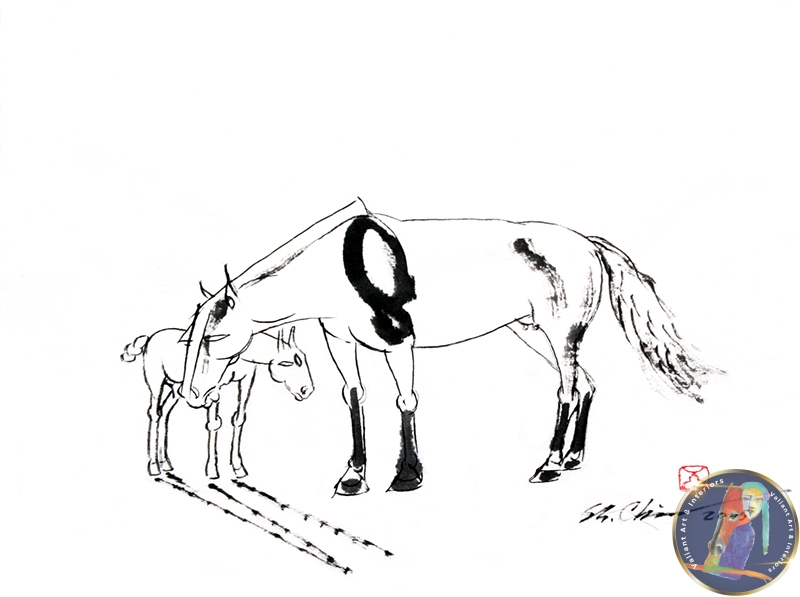
Black and White 29 is a compelling exploration of minimalist abstraction and gestural energy. Executed in traditional ink on paper, the work reflects Shagdarjav’s mastery of line, balancing his background in sculpture with a modern, geometric sensibility.
Composition and Form: The painting is dominated by bold, monochromatic strokes that oscillate between fluid calligraphy and rigid geometric structure. The central focus features a series of intersecting black lines and saturated ink washes that suggest a deconstructed landscape or a skeletal form. The use of negative space—the untouched white of the paper—is as vital as the ink itself, providing a sense of depth and breathability to the dense central arrangement.
Technique and Texture: Shagdarjav utilizes varying densities of ink. In some areas, the application is opaque and heavy, creating sharp, definitive edges that lean into his “Geometric” and “Modern” style associations. In others, the ink thins out, revealing the “dry brush” technique where the texture of the paper fibers breaks through the stroke, adding a kinetic, atmospheric quality reminiscent of traditional East Asian ink wash traditions.
Symbolism and Style: While the work is titled abstractly, there is a rhythmic quality to the brushwork that hints at the vastness of the Mongolian landscape or the movement of livestock, themes often explored by the artist. By stripping away color, Shagdarjav focuses the viewer’s attention entirely on the tension between form and void, and the structural integrity of the composition.
Artist Context
Born in Ulaanbaatar and educated at the State Pedagogical Institute, Chimeddorj Shagdarjav is a pivotal figure in Mongolian contemporary art. His work often bridges the gap between nomadic cultural heritage and international modernism. Black and White 29 serves as a prime example of his ability to translate the physical weight of sculpture into a two-dimensional, graphic format.
