
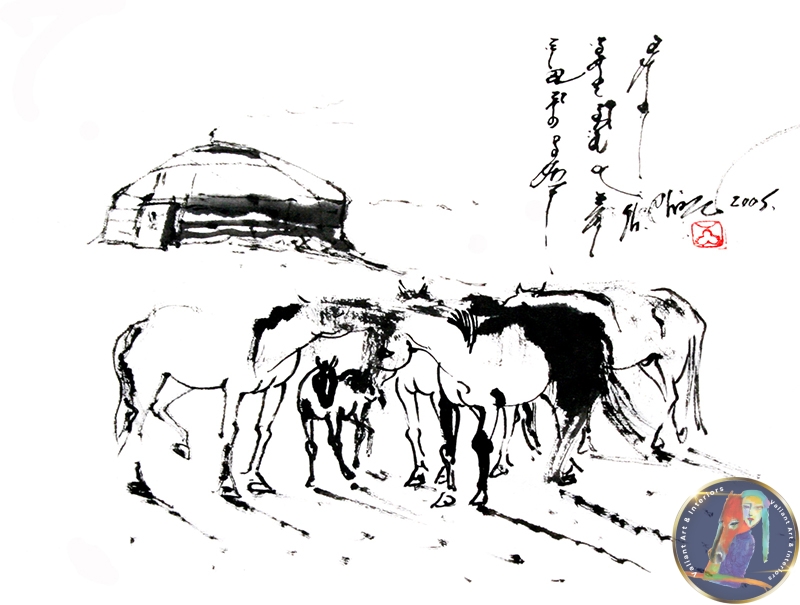
Black And White 27 is a compelling exercise in minimalist abstraction and gestural expression. Executed in traditional ink on paper, the composition is defined by a stark, high-contrast palette that emphasizes the physical movement of the artist’s hand.
Composition and Form: The work features a central, dense cluster of ink applications that radiate outward. Shagdarjav employs a mixture of bold, saturated black strokes and diluted, translucent grey washes. The forms are primarily geometric yet organic, suggesting a fusion of modern architectural structure and the fluid spontaneity of traditional calligraphy.
Technique: There is a visible tension between the controlled “geometric” style and the “abstract” fluidity associated with the artist. Sharp, linear marks intersect with soft, feathered edges where the ink has bled into the paper fibers. This creates a sense of depth and three-dimensionality within a compact $24 \times 26\text{ cm}$ space.
Thematic Resonance: As an artist known for both sculpture and landscape, Shagdarjav’s “Black And White 27” reflects a sculptural approach to two-dimensional space. The heavy application of ink gives the central “mass” a weightiness reminiscent of his physical monuments, while the negative white space surrounding the ink creates a vast, atmospheric quality typical of the Mongolian steppe’s horizon.
Style and Context
Reflecting the Modern and Contemporary Mongolian art movement, this piece moves away from socialist realism toward a universal language of abstraction. The economy of color focuses the viewer’s attention entirely on the texture of the ink and the structural integrity of the shapes. It stands as a sophisticated example of how Shagdarjav translates the monumental scale of his sculptures into the intimate, delicate medium of paper.