
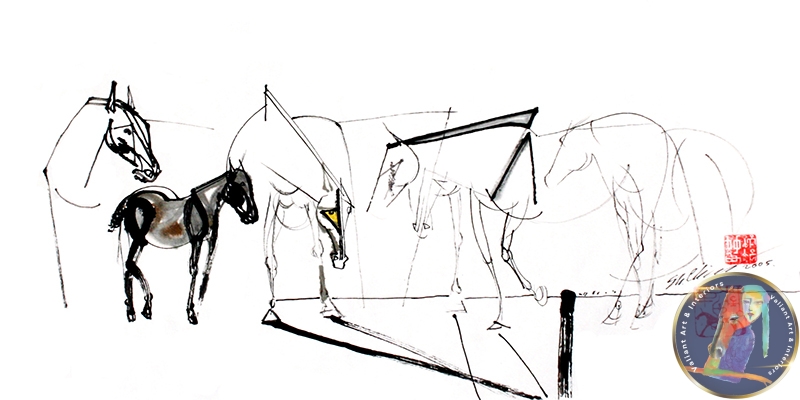
Black and White 22 is a compelling testament to Chimeddorj Shagdarjav’s ability to bridge traditional Mongolian sensibilities with Modernist abstraction. Executed in ink on paper, the work utilizes a panoramic horizontal orientation that emphasizes a sense of movement and expansive space, characteristic of the Mongolian steppe.
Composition and Style
The painting is defined by a high-contrast, monochromatic palette. Shagdarjav employs a sophisticated “Geometric Abstract” approach, where the subject matter—often inspired by the horse or the nomadic horizon—is distilled into its most essential forms.
Linework: The artist uses bold, gestural sweeps of black ink that vary in saturation. Some strokes are “dry,” showing the texture of the paper beneath, while others are saturated and deep, creating a rhythmic cadence across the 55 cm width.
Form: Rather than literal representation, the artist uses sharp angles and overlapping planes to suggest volume and energy. There is a sculptural quality to the ink application, echoing Shagdarjav’s background in three-dimensional art.
Negative Space: The “White” in the title is as active as the “Black.” The untouched areas of the paper function not merely as a background, but as a source of light and a representation of the vast, silent void of the landscape.
Artistic Context
Produced by a graduate of the State Pedagogical Institute and a prominent figure in Mongolian contemporary art, this piece reflects a departure from Socialist Realism toward a more expressive, minimalist language.
The work captures the “Landscape” not through topographical detail, but through the emotional and physical energy of the environment. By stripping away color, Shagdarjav forces the viewer to focus on the raw balance of power and stillness, a recurring theme in his 1954-born generation’s exploration of modern Mongolian identity.