

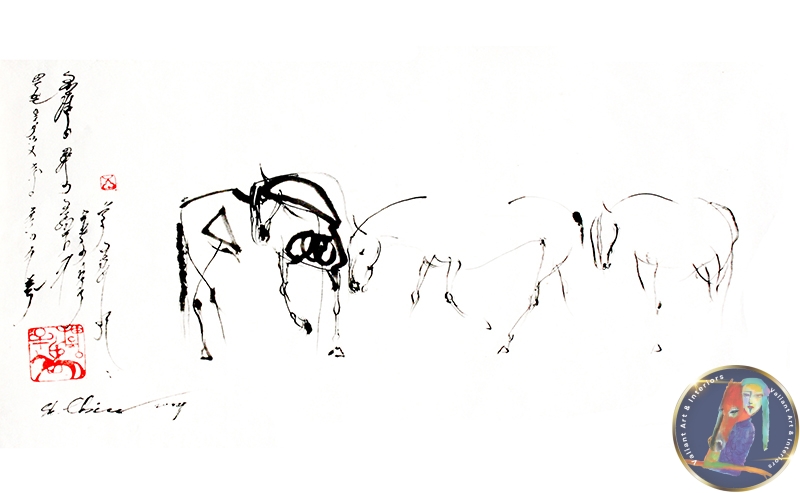
Black and White 19 is a compelling exploration of minimalism and dynamic abstraction, deeply rooted in the East Asian ink wash tradition but filtered through a modern, geometric lens. Executed on a horizontal paper format measuring 25 by 52 cm, the composition relies entirely on the stark contrast between deep carbon-black ink and the natural, unblemished surface of the paper.
Composition and Style
Reflecting Shagdarjav’s background in both sculpture and modern painting, the work treats ink not merely as a pigment, but as a structural element. The painting features:
Fluidity vs. Structure: The artist utilizes bold, sweeping brushstrokes that suggest movement and energy. These forms often evoke the rugged terrain of the Mongolian landscape or the rhythmic silhouette of nomadic life, distilled into abstract shapes.
Geometric Nuance: While the marks appear spontaneous, there is a clear sense of architectural balance. The “Geometric” style associated with Shagdarjav is present in the way the ink occupies defined spaces, creating a tension between the solid black masses and the “negative” white space.
Tonal Variation: Despite the title, the work likely utilizes a range of values—from the “bone-black” intensity of saturated ink to the translucent, feathered grays where the brush begins to run dry (dry-brush technique).
Artistic Context
Born in Tuv Aimag and educated at the State Pedagogical Institute in Ulaanbaatar, Shagdarjav is a pivotal figure in Mongolian contemporary art. In Black and White 19, he bridges the gap between traditional calligraphy and Western abstraction. The lack of figurative detail allows the viewer to focus on the raw emotion of the gesture, making the painting a meditative study on balance, space, and the essential power of the line.
Note on Scale: The intimate horizontal dimensions (25 x 52 cm) suggest a panoramic perspective, common in traditional scroll work, yet the bold execution firmly anchors the piece within the “Modern / Contemporary” movement of the late 20th and early 21st centuries.
