
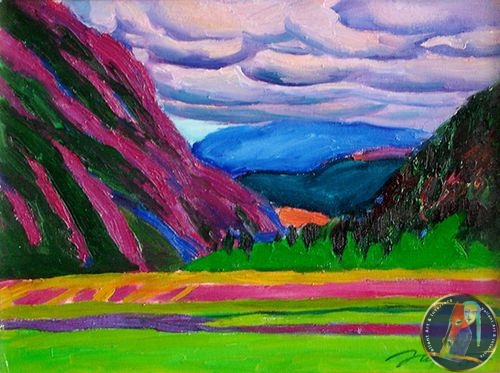
Big Mountain

Enkhjargal Tsagaandari , 2007 , Oil On Canvas

Created in 2007, Big Mountain is a compelling oil-on-canvas work by the acclaimed Mongolian artist Enkhjargal Tsagaandari. Despite its modest dimensions of 30 x 40 cm, the painting captures a sense of monumental scale and rugged tranquility, characteristic of the Mongolian landscape.

Visual Composition and Style

Tsagaandari’s style in this piece sits at the intersection of landscape realism and contemporary abstraction. The composition is dominated by the titular mountain, which serves as a singular, powerful focal point.

  • Color Palette: The artist utilizes a sophisticated range of earthy tones—deep ochres, cool slates, and muted greys—to define the craggy surfaces of the peak. These are often contrasted with the soft, ethereal blues or pale whites of the Mongolian sky, creating a sharp silhouette that emphasizes the mountain’s isolation and grandeur.

  • Brushwork: As an artist with experience in Monumental Art, Tsagaandari applies paint with a confident, textured hand. The brushwork is expressive; visible strokes suggest the weathered textures of ancient rock and the harsh, windswept environment of the high altitudes.

  • Atmosphere: While the subject is a “Big Mountain,” the work feels intimate. It avoids traditional decorative tropes, focusing instead on the figurative weight of the land. There is a “Modernist” economy of line here—nothing is wasted, and the vastness of the Mongolian steppe is implied by what remains off-canvas.

Artistic Context

Born in 1960 in Ulaanbaatar, Enkhjargal Tsagaandari belongs to a generation of Mongolian artists who bridged the gap between traditional techniques and modern, freelance expression.

  • Influence of Experience: Having worked in the UMA (Union of Mongolian Artists) branches and as a teacher at the College of Fine Art, her technical mastery is evident. The “monumental” quality of this 2007 piece likely stems from her earlier professional years in the Monumental Art atelier, where she learned to convey massive scale regardless of the physical size of the canvas.

  • Cultural Connection: Big Mountain is more than a landscape; it is a reflection of the Mongolian identity. In a culture where mountains are often revered as sacred entities, Tsagaandari portrays the peak not just as a geological formation, but as a silent, enduring witness to history.

Historical Significance

By 2007, Tsagaandari had been a freelance artist for seven years, a period marked by increased personal expression away from state-sanctioned institutes. Big Mountain represents this mature phase of her career, distilling decades of observation—from her early exhibitions in Vienna and China to her deep roots in Ulaanbaatar—into a singular, powerful image of her homeland.

  • Enkhjargal Tsagaandari
  • Geometric, Photorealism
  • Oil On Canvas
  • ENJ25/020
  • 30 x 40cm
  • Mongolian Art Gallery

Add Your Comment

Mongolian Art Gallery © 2025. All Rights Reserved
Privacy Policy / Terms of Use

Created in 2007, Big Mountain is a compelling oil-on-canvas work by the acclaimed Mongolian artist Enkhjargal Tsagaandari. Despite its modest dimensions of 30 x 40 cm, the painting captures a sense of monumental scale and rugged tranquility, characteristic of the Mongolian landscape.

Visual Composition and Style

Tsagaandari’s style in this piece sits at the intersection of landscape realism and contemporary abstraction. The composition is dominated by the titular mountain, which serves as a singular, powerful focal point.

  • Color Palette: The artist utilizes a sophisticated range of earthy tones—deep ochres, cool slates, and muted greys—to define the craggy surfaces of the peak. These are often contrasted with the soft, ethereal blues or pale whites of the Mongolian sky, creating a sharp silhouette that emphasizes the mountain’s isolation and grandeur.

  • Brushwork: As an artist with experience in Monumental Art, Tsagaandari applies paint with a confident, textured hand. The brushwork is expressive; visible strokes suggest the weathered textures of ancient rock and the harsh, windswept environment of the high altitudes.

  • Atmosphere: While the subject is a “Big Mountain,” the work feels intimate. It avoids traditional decorative tropes, focusing instead on the figurative weight of the land. There is a “Modernist” economy of line here—nothing is wasted, and the vastness of the Mongolian steppe is implied by what remains off-canvas.

Artistic Context

Born in 1960 in Ulaanbaatar, Enkhjargal Tsagaandari belongs to a generation of Mongolian artists who bridged the gap between traditional techniques and modern, freelance expression.

  • Influence of Experience: Having worked in the UMA (Union of Mongolian Artists) branches and as a teacher at the College of Fine Art, her technical mastery is evident. The “monumental” quality of this 2007 piece likely stems from her earlier professional years in the Monumental Art atelier, where she learned to convey massive scale regardless of the physical size of the canvas.

  • Cultural Connection: Big Mountain is more than a landscape; it is a reflection of the Mongolian identity. In a culture where mountains are often revered as sacred entities, Tsagaandari portrays the peak not just as a geological formation, but as a silent, enduring witness to history.

Historical Significance

By 2007, Tsagaandari had been a freelance artist for seven years, a period marked by increased personal expression away from state-sanctioned institutes. Big Mountain represents this mature phase of her career, distilling decades of observation—from her early exhibitions in Vienna and China to her deep roots in Ulaanbaatar—into a singular, powerful image of her homeland.