

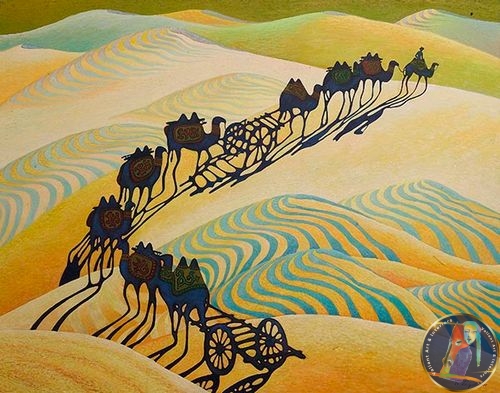
Big Caravan is a masterful synthesis of Tsegmid Tserennadmid’s signature styles, blending Contemporary Expressionism with the traditional soul of Mongolian nomadic life. The painting captures a sense of rhythmic movement across the vastness of the Mongolian landscape, utilizing a wide horizontal canvas (110 x 140 cm) to mirror the infinite horizon of the steppe.
The artist employs a sophisticated Abstract-Landscape approach. Rather than focusing on hyper-realistic anatomical detail, Tserennadmid uses bold, sweeping brushstrokes and a layered impasto technique to evoke the energy and “weight” of the caravan. The figures—likely camels and riders—are rendered with a degree of abstraction, appearing as sturdy, textured forms that seem to emerge directly from the earth.
Color Palette and Texture
The work is characterized by a rich, earthy palette punctuated by the dramatic interplay of light and shadow:
Dominant Tones: Deep ochres, burnt siennas, and sandy beiges represent the rugged terrain.
Expressionist Accents: Vivid strokes of cobalt or sudden flashes of crimson may be used to define the saddles, clothing, or the shifting sky, providing a modern, energetic pulse to a timeless subject.
Surface Quality: The oil medium is applied with visible vitality. The texture is thick and tactile, suggesting the dust of the Gobi and the coarse fur of the livestock, grounding the “Modern” style in physical, organic reality.
Narrative and Symbolism
As an artist born in Ulaanbaatar and deeply rooted in Mongolian academia, Tserennadmid uses the “Caravan” as a metaphor for cultural endurance. The 2007 piece reflects a journey that is both literal and spiritual.
The arrangement of the caravan suggests a slow, inevitable progression. There is a profound sense of “The Kingdom of the Horse” (referencing his 2007 London exhibition) and the camel, signifying the historical Silk Road heritage. The abstraction of the forms suggests that this is not just one specific moment in time, but an eternal cycle of movement that defines the Mongolian identity.
