
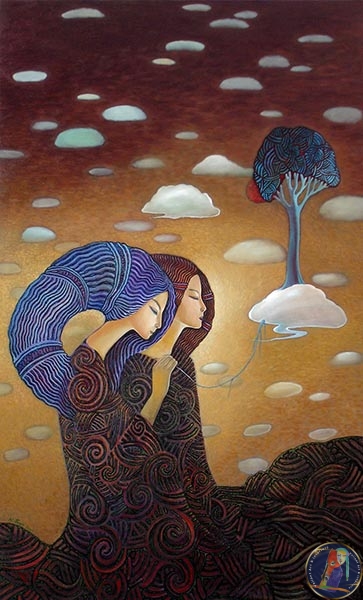
Beauty In The Blue

Tuya Natsagdorj , 2007 , Oil On Canvas

Beauty In The Blue is a striking, large-scale modern figurative painting that masterfully bridges contemporary international modernism with traditional ornamental symbolism. Standing at 150 by 100 centimeters, the vertical canvas features a stylized, ethereal female figure who appears as a mythical goddess or a personification of nature, entirely immersed in a deeply atmospheric world of cool-toned colors.

Subject and Composition

The central focus of the piece is a nude female figure, captured from the waist up. She is positioned in a gentle profile-to-three-quarter view, looking off toward the left side of the canvas. Her posture is elegant and serene, with her hands lightly raised near her torso, their curves mirroring the organic shapes around her.

Her skin is rendered in a soft, luminous pale teal and seafoam green hue, making her appear otherworldly—almost translucent against the vibrant backdrop. Rather than realistic anatomy, her form is defined by long, smooth, elegant contours that prioritize movement and symbolic grace.

The Hair and Flowing Elements

The most dominant and visually arresting feature of the painting is the figure’s massive, stylized mane of hair. Transformed into deep emerald and forest green ribbons, the hair behaves like thick, flowing strands of sea grass, kelp, or rhythmic wind currents.

  • Movement: The hair explodes outwards from her head, sweeping dynamically across the upper and right portions of the frame. It twists, turns, and cascades downward, partially wrapping around her body like a natural garment.

  • Texture: Each individual section of the hair is finely textured with linear, parallel grooves and highlights, emphasizing structural form, rhythm, and a sense of hypnotic repetition that feels deeply tied to East Asian decorative art traditions.

Color Palette and Background

True to its title, the background of the painting is a rich, swirling tempest of cold, cosmic colors.

  • Dominant Hues: Deep indigos, rich royal blues, and twilight purples form the core of the environment, giving the impression of an underwater abyss, a nocturnal sky, or a spiritual dreamscape.

  • Atmospheric Light: Interspersed within the heavy blues and purples are mottled, impressionistic strokes of magenta, soft pink, and lighter turquoise. These strokes appear like scattered stardust, bioluminescent particles, or refracting light under water, adding incredible depth and a pulsing energy to the space surrounding the serene entity.

Artistic Style and Mood

The execution reflects Tuya Natsagdorj’s diverse background—blending the theatrical, graphic composition skills developed during scene painting studies in Ukraine with the delicate appreciation for line, space, and nature refined in Japan.

There is an intense stillness in the woman’s facial expression—marked by minimalist, clean lines for her eyes and lips—which contrasts beautifully with the wild, rhythmic motion of her hair and the chaotic beauty of the colorful void around her. The overall mood is one of quiet power, mystical isolation, and the sublime harmony between a feminine spirit and the cosmos.
  • Tuya Natsagdorj
  • Ulaanbaatar, Mongolia
  • Abstract, Expressionist, Figurative, Modern/Contemporary, Still Life
  • Oil on canvas
  • TUY49/015
  • 150 x 100cm59" x 39"
  • Valiant Art & Interiors

Add Your Comment

Mongolian Art Gallery © 2025. All Rights Reserved
Privacy Policy / Terms of Use

Beauty In The Blue is a striking, large-scale modern figurative painting that masterfully bridges contemporary international modernism with traditional ornamental symbolism. Standing at 150 by 100 centimeters, the vertical canvas features a stylized, ethereal female figure who appears as a mythical goddess or a personification of nature, entirely immersed in a deeply atmospheric world of cool-toned colors.

Subject and Composition

The central focus of the piece is a nude female figure, captured from the waist up. She is positioned in a gentle profile-to-three-quarter view, looking off toward the left side of the canvas. Her posture is elegant and serene, with her hands lightly raised near her torso, their curves mirroring the organic shapes around her.

Her skin is rendered in a soft, luminous pale teal and seafoam green hue, making her appear otherworldly—almost translucent against the vibrant backdrop. Rather than realistic anatomy, her form is defined by long, smooth, elegant contours that prioritize movement and symbolic grace.

The Hair and Flowing Elements

The most dominant and visually arresting feature of the painting is the figure’s massive, stylized mane of hair. Transformed into deep emerald and forest green ribbons, the hair behaves like thick, flowing strands of sea grass, kelp, or rhythmic wind currents.

  • Movement: The hair explodes outwards from her head, sweeping dynamically across the upper and right portions of the frame. It twists, turns, and cascades downward, partially wrapping around her body like a natural garment.

  • Texture: Each individual section of the hair is finely textured with linear, parallel grooves and highlights, emphasizing structural form, rhythm, and a sense of hypnotic repetition that feels deeply tied to East Asian decorative art traditions.

Color Palette and Background

True to its title, the background of the painting is a rich, swirling tempest of cold, cosmic colors.

  • Dominant Hues: Deep indigos, rich royal blues, and twilight purples form the core of the environment, giving the impression of an underwater abyss, a nocturnal sky, or a spiritual dreamscape.

  • Atmospheric Light: Interspersed within the heavy blues and purples are mottled, impressionistic strokes of magenta, soft pink, and lighter turquoise. These strokes appear like scattered stardust, bioluminescent particles, or refracting light under water, adding incredible depth and a pulsing energy to the space surrounding the serene entity.

Artistic Style and Mood

The execution reflects Tuya Natsagdorj’s diverse background—blending the theatrical, graphic composition skills developed during scene painting studies in Ukraine with the delicate appreciation for line, space, and nature refined in Japan.

There is an intense stillness in the woman’s facial expression—marked by minimalist, clean lines for her eyes and lips—which contrasts beautifully with the wild, rhythmic motion of her hair and the chaotic beauty of the colorful void around her. The overall mood is one of quiet power, mystical isolation, and the sublime harmony between a feminine spirit and the cosmos.