
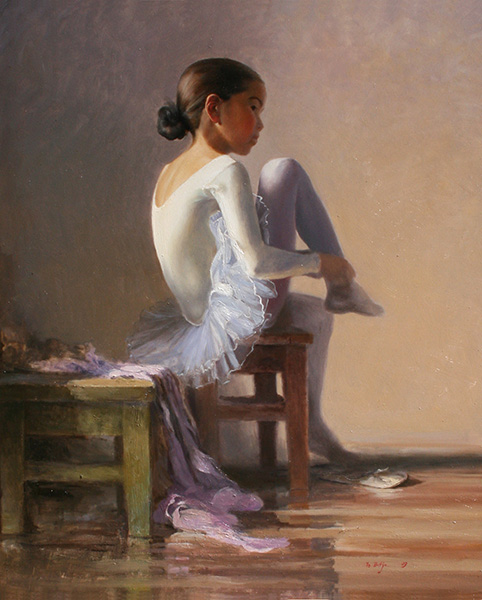
Ballerina School

Batjargal Tseintsogzol , 2009 , Oil On Canvas

Ballerina School (2009) is a masterclass in light and texture by the late Mongolian artist Batjargal Tseintsogzol. Measuring 81 x 65 cm, this oil-on-canvas work exemplifies the artist’s dedication to Photorealism, capturing a quiet, disciplined moment within a dance studio.

Visual Composition and Subject Matter

The painting depicts a group of young ballerinas in the midst of practice. Rather than focusing on a grand performance, Tseintsogzol chooses an intimate, “behind-the-scenes” perspective. The composition is likely structured around the rhythm of the dancers’ bodies—the repetitive lines of their legs, the soft curves of their tutus, and the rigid, horizontal line of the ballet barre.

Lighting and Atmosphere

Tseintsogzol was renowned for his ability to manipulate light to create a sense of depth and realism.

  • Chiaroscuro Effects: The painting likely employs a soft, directional light source (perhaps an unseen window) that grazes the dancers’ silhouettes. This creates a high-contrast environment where the “glow” of the white tutus pops against a more muted, atmospheric background.

  • Soft Focus: While the primary subjects are rendered with crisp, photorealistic detail, the background may slightly blur, mimicking the depth of field found in professional photography.

Technical Mastery

As a proponent of Realism and Nature, Tseintsogzol’s technique in Ballerina School is characterized by:

  • Textural Precision: The viewer can almost feel the difference between the stiff tulle of the tutus, the satin of the pointe shoes, and the polished wood of the studio floor.

  • Anatomical Accuracy: Reflecting his mastery of the human form, the musculature and posture of the dancers are rendered with clinical precision, capturing the physical strain hidden behind the grace of ballet.

About the Artist: Batjargal Tseintsogzol (1966–2020)

Born in Ulaanbaatar, Tseintsogzol was a pivotal figure in Mongolian contemporary art. He moved away from traditional Mongolian styles to embrace Western Realism. His work often bridges the gap between the stillness of a photograph and the soul of a painting, focusing on subjects that require immense technical skill to replicate—such as the translucency of fabric or the play of light on skin.

Note: His legacy is defined by this “quiet realism,” where the subject matter is less about a narrative and more about the beauty of form and the physics of light.

  • Batjargal Tseintsogzol
  • Mongolian Style, Still Life
  • Oil On Canvas
  • BTJ8/100
  • 81 x 65cm
  • Mongolian Art Gallery

Add Your Comment

Mongolian Art Gallery © 2025. All Rights Reserved
Privacy Policy / Terms of Use

Ballerina School (2009) is a masterclass in light and texture by the late Mongolian artist Batjargal Tseintsogzol. Measuring 81 x 65 cm, this oil-on-canvas work exemplifies the artist’s dedication to Photorealism, capturing a quiet, disciplined moment within a dance studio.

Visual Composition and Subject Matter

The painting depicts a group of young ballerinas in the midst of practice. Rather than focusing on a grand performance, Tseintsogzol chooses an intimate, “behind-the-scenes” perspective. The composition is likely structured around the rhythm of the dancers’ bodies—the repetitive lines of their legs, the soft curves of their tutus, and the rigid, horizontal line of the ballet barre.

Lighting and Atmosphere

Tseintsogzol was renowned for his ability to manipulate light to create a sense of depth and realism.

  • Chiaroscuro Effects: The painting likely employs a soft, directional light source (perhaps an unseen window) that grazes the dancers’ silhouettes. This creates a high-contrast environment where the “glow” of the white tutus pops against a more muted, atmospheric background.

  • Soft Focus: While the primary subjects are rendered with crisp, photorealistic detail, the background may slightly blur, mimicking the depth of field found in professional photography.

Technical Mastery

As a proponent of Realism and Nature, Tseintsogzol’s technique in Ballerina School is characterized by:

  • Textural Precision: The viewer can almost feel the difference between the stiff tulle of the tutus, the satin of the pointe shoes, and the polished wood of the studio floor.

  • Anatomical Accuracy: Reflecting his mastery of the human form, the musculature and posture of the dancers are rendered with clinical precision, capturing the physical strain hidden behind the grace of ballet.

About the Artist: Batjargal Tseintsogzol (1966–2020)

Born in Ulaanbaatar, Tseintsogzol was a pivotal figure in Mongolian contemporary art. He moved away from traditional Mongolian styles to embrace Western Realism. His work often bridges the gap between the stillness of a photograph and the soul of a painting, focusing on subjects that require immense technical skill to replicate—such as the translucency of fabric or the play of light on skin.

Note: His legacy is defined by this “quiet realism,” where the subject matter is less about a narrative and more about the beauty of form and the physics of light.