
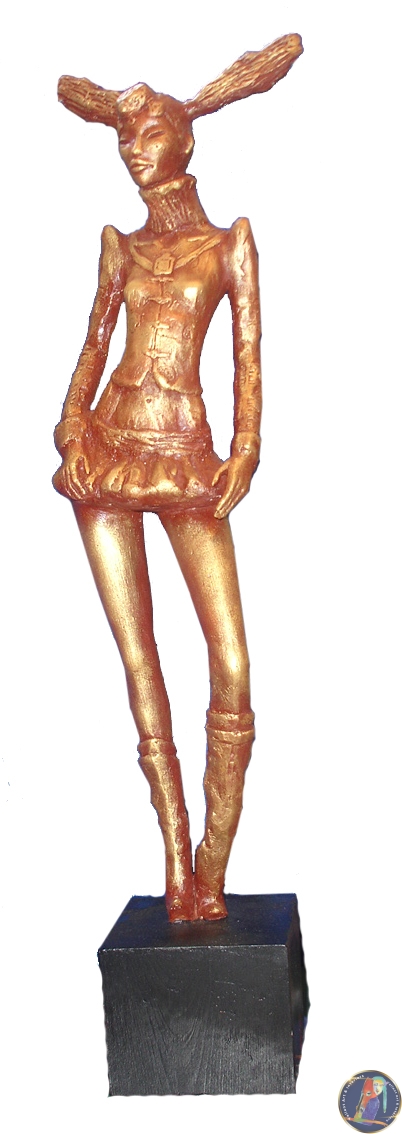
Ballerina

Sukhburen Narankhuu , 2008 , Ceramic

This 2008 ceramic sculpture, titled Ballerina, is a compelling representative of Sukhburen Narankhuu’s ability to translate the fluid grace of dance into the rigid medium of clay. Standing at 45cm in height, the piece captures a moment of poised stillness that suggests both physical strength and ethereal lightness.

Visual Composition and Form

The sculpture depicts a stylized female figure in a classical balletic pose. Narankhuu eschews hyper-realism in favor of elongated proportions and smooth, flowing contours that emphasize the “line” of the dancer.

  • The Silhouette: The figure is characterized by slender limbs and a delicate, tapering neck. The posture conveys a sense of upward momentum, as if the ceramic form is defying its own weight.

  • Surface Texture: The ceramic finish is typically executed with a refined smoothness, highlighting the play of light and shadow over the anatomical curves. Depending on the specific glaze used in this edition, the surface often possesses a soft, satin-like sheen that mimics the taut skin of an athlete.

  • The Tutu: A signature element of Narankhuu’s Ballerina series is the treatment of the skirt. Rather than fabric, the ceramic is manipulated into thin, crisp layers or a singular flared disk that provides a sharp geometric contrast to the organic curves of the torso and legs.


Artistic Style and Context

Narankhuu, born in Ulaanbaatar in 1982, is a prominent figure in contemporary Mongolian sculpture. His work often bridges the gap between traditional craftsmanship and modern aesthetic sensibilities.

  • Sculptural Approach: In Ballerina, Narankhuu utilizes the 360-degree nature of sculpture to ensure the composition is dynamic from every angle. The negative space between the arms and the torso is as considered as the solid form itself.

  • Thematic Resonance: While the subject is a Western classical tradition, Narankhuu infuses it with a minimalist elegance common in modern Mongolian fine arts. The piece focuses on the internal discipline of the dancer, represented through the balance and structural integrity of the ceramic.

  • Sukhburen Narankhuu
  • Abstract, Figurative
  • Ceramic
  • H - 45cm
  • Not Available
  • Mongolian Art Gallery

Add Your Comment

Mongolian Art Gallery © 2025. All Rights Reserved
Privacy Policy / Terms of Use

This 2008 ceramic sculpture, titled Ballerina, is a compelling representative of Sukhburen Narankhuu’s ability to translate the fluid grace of dance into the rigid medium of clay. Standing at 45cm in height, the piece captures a moment of poised stillness that suggests both physical strength and ethereal lightness.

Visual Composition and Form

The sculpture depicts a stylized female figure in a classical balletic pose. Narankhuu eschews hyper-realism in favor of elongated proportions and smooth, flowing contours that emphasize the “line” of the dancer.

  • The Silhouette: The figure is characterized by slender limbs and a delicate, tapering neck. The posture conveys a sense of upward momentum, as if the ceramic form is defying its own weight.

  • Surface Texture: The ceramic finish is typically executed with a refined smoothness, highlighting the play of light and shadow over the anatomical curves. Depending on the specific glaze used in this edition, the surface often possesses a soft, satin-like sheen that mimics the taut skin of an athlete.

  • The Tutu: A signature element of Narankhuu’s Ballerina series is the treatment of the skirt. Rather than fabric, the ceramic is manipulated into thin, crisp layers or a singular flared disk that provides a sharp geometric contrast to the organic curves of the torso and legs.


Artistic Style and Context

Narankhuu, born in Ulaanbaatar in 1982, is a prominent figure in contemporary Mongolian sculpture. His work often bridges the gap between traditional craftsmanship and modern aesthetic sensibilities.

  • Sculptural Approach: In Ballerina, Narankhuu utilizes the 360-degree nature of sculpture to ensure the composition is dynamic from every angle. The negative space between the arms and the torso is as considered as the solid form itself.

  • Thematic Resonance: While the subject is a Western classical tradition, Narankhuu infuses it with a minimalist elegance common in modern Mongolian fine arts. The piece focuses on the internal discipline of the dancer, represented through the balance and structural integrity of the ceramic.