
Ballerina

Ulziijavkhlan Adyabaatar , 2009 , Oil On Canvas

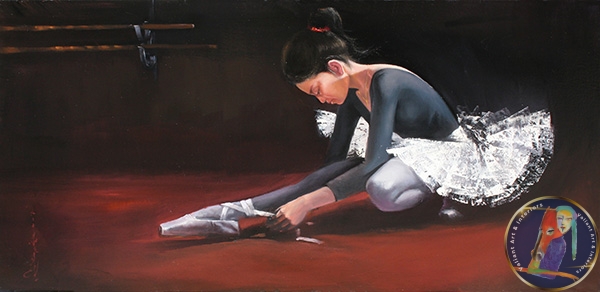
Ballerina (2009) is a striking oil-on-canvas painting that stands out for its distinct, elongated horizontal orientation ($50 \times 100\text{ cm}$). This panoramic ratio creates a wide cinematic field, shifting the focus from a traditional vertical portrait of a dancer to a more spacious, atmospheric study of form and environment.

The composition is centered around the single figure of a ballerina, capturing a quiet, introspective moment rather than an explosive, mid-leap theatrical movement. The positioning of the dancer within the wide canvas emphasizes a sense of isolation, poise, and immense focus.

Subject Matter & Form

The central subject is a female ballerina captured in a moment of rest or intense preparation.

  • The Pose: Rather than performing under stage lights, the dancer is depicted in a deeply personal, vulnerable pose—likely seated or in a low, grounded stretch that spans across a portion of the wide canvas. Her body lines are sharp and elegant, highlighting the physical discipline of ballet.

  • The Attire: She wears a classic, textured tutu and pointe shoes. The artist uses careful, layered brushwork to contrast the soft, airy, translucent fabric of the tutu against the solid, muscular form of the dancer’s limbs.

Color Palette & Atmospheric Style

Adyabaatar’s signature realist approach leans heavily on creating a serene, highly atmospheric background.

  • The Background: Instead of a detailed backstage or theater setting, the background is rendered with smooth, soft color gradients and muted tones—blending earthy hues, deep shadows, and soft ambient light. This minimalist backdrop ensures that the viewer’s eye is drawn entirely to the contour of the dancer.

  • Chiaroscuro Effect: The painting utilizes a beautiful play of light and shadow (chiaroscuro). A focused light source illuminates the ballerina from one side, catching the edges of her costume, the curve of her spine, and the satin ribbon of her shoes, while leaving the rest of the canvas in a calm, meditative dimness.

Mood and Texture

The texture of the oil paint is varied; it is applied smoothly across the background to give a sense of infinite, quiet space, while featuring more tactile, thicker applications on the dancer’s costume to catch the light.

The overall mood is one of profound stillness and internal strength. By removing the noise of an audience or a stage, the painting becomes an intimate portrait of dedication, capturing the quiet dignity of an artist in her element.

  • Ulziijavkhlan Adyabaatar
  • Dund Gobi, Mongolia
  • Figurative, Landscape, Nature, Portrait, Realism
  • Oil on canvas
  • ULZ83/009
  • 50 x 100cm19" x 39"
  • Valiant Art & Interiors

Add Your Comment

Mongolian Art Gallery © 2025. All Rights Reserved
Privacy Policy / Terms of Use

Ballerina (2009) is a striking oil-on-canvas painting that stands out for its distinct, elongated horizontal orientation ($50 \times 100\text{ cm}$). This panoramic ratio creates a wide cinematic field, shifting the focus from a traditional vertical portrait of a dancer to a more spacious, atmospheric study of form and environment.

The composition is centered around the single figure of a ballerina, capturing a quiet, introspective moment rather than an explosive, mid-leap theatrical movement. The positioning of the dancer within the wide canvas emphasizes a sense of isolation, poise, and immense focus.

Subject Matter & Form

The central subject is a female ballerina captured in a moment of rest or intense preparation.

  • The Pose: Rather than performing under stage lights, the dancer is depicted in a deeply personal, vulnerable pose—likely seated or in a low, grounded stretch that spans across a portion of the wide canvas. Her body lines are sharp and elegant, highlighting the physical discipline of ballet.

  • The Attire: She wears a classic, textured tutu and pointe shoes. The artist uses careful, layered brushwork to contrast the soft, airy, translucent fabric of the tutu against the solid, muscular form of the dancer’s limbs.

Color Palette & Atmospheric Style

Adyabaatar’s signature realist approach leans heavily on creating a serene, highly atmospheric background.

  • The Background: Instead of a detailed backstage or theater setting, the background is rendered with smooth, soft color gradients and muted tones—blending earthy hues, deep shadows, and soft ambient light. This minimalist backdrop ensures that the viewer’s eye is drawn entirely to the contour of the dancer.

  • Chiaroscuro Effect: The painting utilizes a beautiful play of light and shadow (chiaroscuro). A focused light source illuminates the ballerina from one side, catching the edges of her costume, the curve of her spine, and the satin ribbon of her shoes, while leaving the rest of the canvas in a calm, meditative dimness.

Mood and Texture

The texture of the oil paint is varied; it is applied smoothly across the background to give a sense of infinite, quiet space, while featuring more tactile, thicker applications on the dancer’s costume to catch the light.

The overall mood is one of profound stillness and internal strength. By removing the noise of an audience or a stage, the painting becomes an intimate portrait of dedication, capturing the quiet dignity of an artist in her element.