
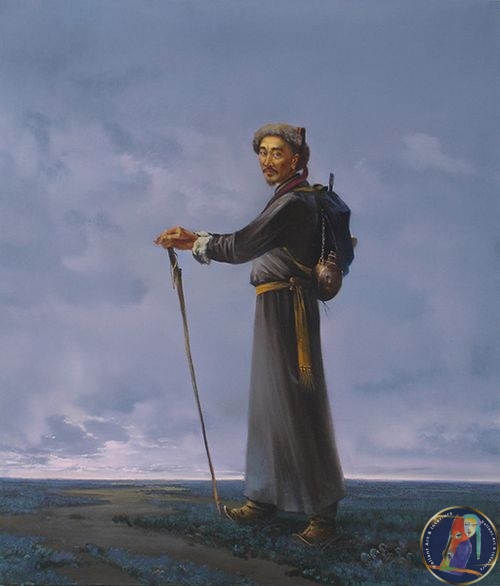
Badarchin

Khurelbaatar Choindon , 2006 , Oil On Canvas

The painting Badarchin is a masterclass in photorealism and figurative storytelling, deeply rooted in Mongolian heritage. The title refers to a “Badarchin”—a wandering pilgrim or mendicant monk traditional to Mongolian culture—who traveled on foot to various monasteries, carrying their meager belongings and a staff.

The Subject

  • The Figure: The central focus is an elderly man, his face a map of deep-set wrinkles and sun-weathered skin, rendered with the anatomical precision for which Choindon is renowned. His expression is one of quiet resilience and spiritual detachment.

  • Attire: He is dressed in a traditional Mongolian deel, depicted with heavy textures that suggest the dust of the road and the wear of the elements. The play of light on the fabric highlights the artist’s training at the Repin Academy, showcasing a sophisticated understanding of chiaroscuro (the contrast between light and dark).

  • The Burden: Across his back, he carries a traditional pack. The intricate details—from the frayed ropes to the specific way his hands grip a wooden staff—ground the piece in a gritty, tactile reality.

Style and Technique

Choindon blends the rigorous academic training of the Russian Realist school with the vast, emotive soul of the Mongolian Landscape.

  • Photorealism: Every whisker of the pilgrim’s beard and the translucent quality of his eyes are captured with high-definition clarity.

  • Atmosphere: While the figure is the anchor, the background often features the soft, muted tones of the Mongolian steppe or a hazy sky, emphasizing the isolation and vastness of the pilgrim’s journey.

  • Color Palette: The artist utilizes an earthy, organic palette—ochres, deep browns, slate greys, and muted blues—which reflects the natural environment of Mongolia and the ascetic life of the Badarchin.


Cultural Context

Created in 2006, while Choindon served as the Vice Chairman of the Union of Mongolian Artists (UMA), this painting serves as a bridge between the old world and the new. It captures a vanishing way of life. By applying the polished techniques of European fine art to a uniquely nomadic subject, Choindon elevates the humble wanderer to a figure of monumental dignity.

Key Insight: Badarchin is not merely a portrait; it is an exploration of the passage of time and the endurance of the Mongolian spirit. The 72 x 61 cm scale creates an intimate, almost confrontational experience, forcing the viewer to look directly into the eyes of a man who has walked a thousand miles in silence.
  • Khurelbaatar Choindon
  • Landscape, Nature
  • Oil On Canvas
  • KBR31/020
  • 72 x 61cm
  • Mongolian Art Gallery

Add Your Comment

Mongolian Art Gallery © 2025. All Rights Reserved
Privacy Policy / Terms of Use

The painting Badarchin is a masterclass in photorealism and figurative storytelling, deeply rooted in Mongolian heritage. The title refers to a “Badarchin”—a wandering pilgrim or mendicant monk traditional to Mongolian culture—who traveled on foot to various monasteries, carrying their meager belongings and a staff.

The Subject

  • The Figure: The central focus is an elderly man, his face a map of deep-set wrinkles and sun-weathered skin, rendered with the anatomical precision for which Choindon is renowned. His expression is one of quiet resilience and spiritual detachment.

  • Attire: He is dressed in a traditional Mongolian deel, depicted with heavy textures that suggest the dust of the road and the wear of the elements. The play of light on the fabric highlights the artist’s training at the Repin Academy, showcasing a sophisticated understanding of chiaroscuro (the contrast between light and dark).

  • The Burden: Across his back, he carries a traditional pack. The intricate details—from the frayed ropes to the specific way his hands grip a wooden staff—ground the piece in a gritty, tactile reality.

Style and Technique

Choindon blends the rigorous academic training of the Russian Realist school with the vast, emotive soul of the Mongolian Landscape.

  • Photorealism: Every whisker of the pilgrim’s beard and the translucent quality of his eyes are captured with high-definition clarity.

  • Atmosphere: While the figure is the anchor, the background often features the soft, muted tones of the Mongolian steppe or a hazy sky, emphasizing the isolation and vastness of the pilgrim’s journey.

  • Color Palette: The artist utilizes an earthy, organic palette—ochres, deep browns, slate greys, and muted blues—which reflects the natural environment of Mongolia and the ascetic life of the Badarchin.


Cultural Context

Created in 2006, while Choindon served as the Vice Chairman of the Union of Mongolian Artists (UMA), this painting serves as a bridge between the old world and the new. It captures a vanishing way of life. By applying the polished techniques of European fine art to a uniquely nomadic subject, Choindon elevates the humble wanderer to a figure of monumental dignity.

Key Insight: Badarchin is not merely a portrait; it is an exploration of the passage of time and the endurance of the Mongolian spirit. The 72 x 61 cm scale creates an intimate, almost confrontational experience, forcing the viewer to look directly into the eyes of a man who has walked a thousand miles in silence.