
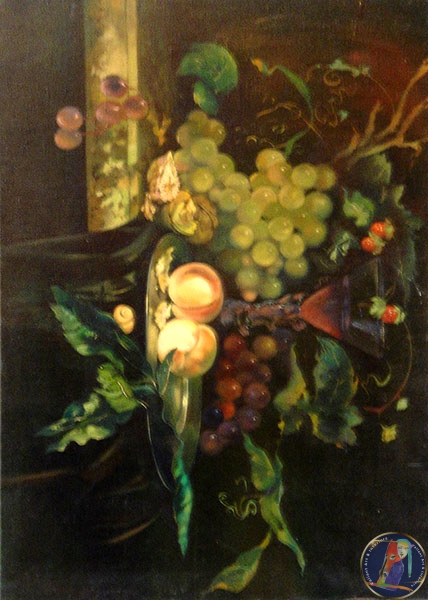
In this vertical-format still life, the viewer’s focus is anchored by the singular presence of a ripe apple. While the title is singular, Dorj often explores the relationship between the object and the negative space surrounding it. The 70 x 50 cm canvas provides a generous stage for the fruit, which is positioned with a sense of deliberate weight and monumentalism that transcends its actual size.
Color Palette and Lighting
Drawing from her rigorous education at the Surikov Fine Art Academy in Moscow, Dorj employs a sophisticated use of “Chiaroscuro” (the contrast of light and dark).
The Fruit: The apple is rendered in a rich spectrum of reds, ranging from deep crimson and burnt sienna in the shadows to vibrant vermilion and cadmium red where the light hits the skin.
The Atmosphere: The background is typically muted—often a series of earthy umbers or cool greys—which allows the saturated tones of the apple to “pop” forward, creating a 3D effect characteristic of high Realism.
Technique and Texture
As an oil on canvas work, “Apple” showcases Dorj’s mastery of the medium:
Brushwork: There is a seamless transition between colors, suggesting the use of soft glazing techniques. The surface of the apple appears taut and glossy, with a tiny, sharp stroke of zinc white representing a specular highlight (the reflection of a light source).
Realism: True to her associated style, the artist does not shy away from imperfections. One might find subtle “stings” or slight textural irregularities on the apple’s skin, grounding the piece in organic reality rather than stylized perfection.
Artistic Context
Created in 2005, during her period as a freelance artist, this painting serves as a bridge between her Mongolian heritage and the Russian academic tradition. The simplicity of the subject matter—a staple of the Still Life genre—allows Dorj to showcase the technical discipline she honed during her decade-long study in Moscow (1989–1998).
The work reflects a quiet, meditative quality. By isolating a single piece of fruit, Dorj invites the viewer to appreciate the physics of light, the gravity of the object, and the quiet beauty of a common item, elevated to the status of a portrait.