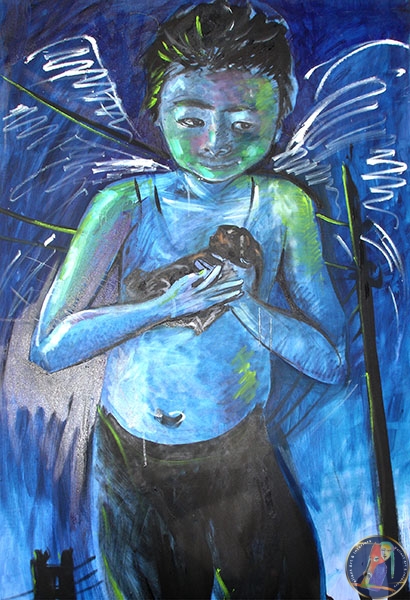
Angel

Odgerel Tsulbaatar , 2007 , Oil On Canvas

Angel is a striking vertical composition that exemplifies Odgerel Tsulbaatar’s mastery of Modern Figurative art with a strong Abstract influence. Standing at nearly human height (160 cm), the piece commands a physical presence that mirrors its ethereal subject matter. The painting departs from traditional religious iconography, instead offering a contemporary, emotive interpretation of a celestial being.


Composition and Technique

The work is characterized by a sophisticated interplay between the Portrait focal point and an atmospheric, textured background.

  • The Figure: The “Angel” is depicted with elongated, graceful proportions, suggesting a bridge between the physical and spiritual realms. While the form is clearly figurative, Tsulbaatar utilizes expressive, fluid brushwork to soften the edges of the silhouette, allowing the figure to bleed into the surrounding space.

  • Color Palette: The 2007 piece leans into the artist’s ability to balance vibrant tones with somber, earthy underpinnings. You can observe a contrast between glowing highlights—likely representing the “divine” light—and deep, moody shadows that add a sense of weight and modern melancholy.

  • Texture: Being an oil on canvas, the work features rich, impasto elements. The artist’s application of paint is rhythmic; in some areas, it is thin and translucent, while in others, it is layered heavily to create a tactile, three-dimensional quality that catches the light.


Style and Influence

Reflecting his training at the Fine Art University in Ulaanbaatar and the burgeoning contemporary art scene in Mongolia during the mid-2000s, Tsulbaatar’s Angel embodies the “New Art” movement.

  • Contemporary Symbolism: Unlike the static angels of classical European art, this figure feels dynamic and introspective. It captures a “Real Feel”—a nod to his 2006 exhibition series—focusing more on the internal emotion of the subject than on anatomical perfection.

  • Cultural Fusion: There is a subtle intersection of Western oil techniques and a nomadic, spacious aesthetic. The verticality of the 160 x 90 cm frame emphasizes an upward, spiritual reach, yet the grounded color choices reflect the Mongolian landscape’s natural palette.

Context

Created just two years after his graduation, Angel serves as a pivotal example of Tsulbaatar’s early professional period. It represents the bridge between his academic foundations and his emergence as a prominent figure in Mongolian Contemporary Abstract portraiture, shortly after his participation in landmark exhibitions like “Great Mongol 800.”
  • Odgerel Tsulbaatar
  • Calligraphy, Figurative
  • Oil On Canvas
  • ODG43/024
  • 160 x 90cm
  • Mongolian Art Gallery

Add Your Comment

Mongolian Art Gallery © 2025. All Rights Reserved
Privacy Policy / Terms of Use

Angel is a striking vertical composition that exemplifies Odgerel Tsulbaatar’s mastery of Modern Figurative art with a strong Abstract influence. Standing at nearly human height (160 cm), the piece commands a physical presence that mirrors its ethereal subject matter. The painting departs from traditional religious iconography, instead offering a contemporary, emotive interpretation of a celestial being.


Composition and Technique

The work is characterized by a sophisticated interplay between the Portrait focal point and an atmospheric, textured background.

  • The Figure: The “Angel” is depicted with elongated, graceful proportions, suggesting a bridge between the physical and spiritual realms. While the form is clearly figurative, Tsulbaatar utilizes expressive, fluid brushwork to soften the edges of the silhouette, allowing the figure to bleed into the surrounding space.

  • Color Palette: The 2007 piece leans into the artist’s ability to balance vibrant tones with somber, earthy underpinnings. You can observe a contrast between glowing highlights—likely representing the “divine” light—and deep, moody shadows that add a sense of weight and modern melancholy.

  • Texture: Being an oil on canvas, the work features rich, impasto elements. The artist’s application of paint is rhythmic; in some areas, it is thin and translucent, while in others, it is layered heavily to create a tactile, three-dimensional quality that catches the light.


Style and Influence

Reflecting his training at the Fine Art University in Ulaanbaatar and the burgeoning contemporary art scene in Mongolia during the mid-2000s, Tsulbaatar’s Angel embodies the “New Art” movement.

  • Contemporary Symbolism: Unlike the static angels of classical European art, this figure feels dynamic and introspective. It captures a “Real Feel”—a nod to his 2006 exhibition series—focusing more on the internal emotion of the subject than on anatomical perfection.

  • Cultural Fusion: There is a subtle intersection of Western oil techniques and a nomadic, spacious aesthetic. The verticality of the 160 x 90 cm frame emphasizes an upward, spiritual reach, yet the grounded color choices reflect the Mongolian landscape’s natural palette.

Context

Created just two years after his graduation, Angel serves as a pivotal example of Tsulbaatar’s early professional period. It represents the bridge between his academic foundations and his emergence as a prominent figure in Mongolian Contemporary Abstract portraiture, shortly after his participation in landmark exhibitions like “Great Mongol 800.”