
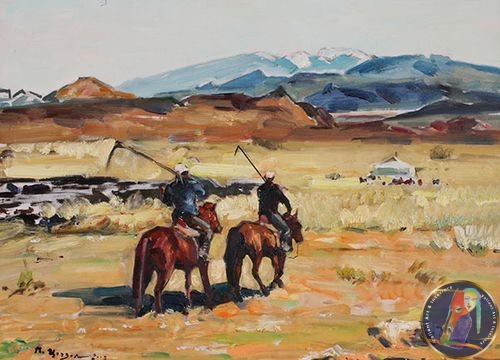
Aduuchin (The Horse Herder) is a masterful display of Mongolian Realism, capturing the visceral energy and vast scale of the Eastern Mongolian steppe. Painted toward the end of Tsogzol Purev’s life, the work reflects his deep intimacy with the landscape of his birthplace, Dornod.
Composition and Subject Matter
The painting depicts a traditional Mongolian aduuchin (horse herder) in the heat of a drive. The composition is dynamic, defined by a sense of urgent, horizontal motion that sweeps across the canvas.
The Central Figure: A lone rider is positioned as the focal point, mounted on a sturdy Mongolian horse. He is captured in mid-gallop, his body leaning slightly into the wind, embodying the stoic grace and rugged endurance central to nomadic culture.
The Herd: Surrounding the herder is a sea of horses. Purev uses expert brushwork to suggest a massive, thundering herd without over-detailing every animal. The horses are rendered in a variety of earthy tones—bay, chestnut, and grey—their forms blurring slightly to convey speed and the kicking up of dust.
The Landscape: True to the artist’s background in cinematic production design, the background is treated with an expansive, panoramic perspective. The vast steppe stretches toward a low horizon line, under a sky that feels immense and heavy with the atmosphere of the high plains.
Technique and Style
Tsogzol Purev’s dual training in traditional Mongolian fine arts and Soviet-era cinematic design (at the Federal Movie Art Institute in Moscow) is evident in the painting’s execution:
Cinematic Realism: The painting feels like a “still” from a motion picture. There is a profound sense of “mise-en-scène”—the lighting suggests the harsh, clear light of midday, creating high contrast and deep shadows that give the figures a sculptural quality.
Color Palette: The palette is dominated by natural, organic hues. Rich ochres, burnt sienna, and sage greens ground the piece, while the sky utilizes subtle gradients of blue and pale white to emphasize the thin, cold air of the Mongolian plateau.
Textural Brushwork: Unlike the flat, decorative style of Mongol Zurag, Purev employs thick, confident oil strokes. You can almost feel the texture of the horse’s coat and the dry grass of the steppe.