
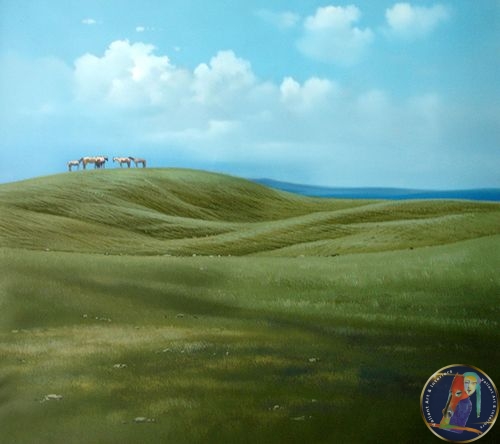
The painting features five horses positioned atop a gentle incline, set against a vast, atmospheric landscape. The composition is grounded in Realism, yet it possesses a quiet, cinematic quality that elevates the scene beyond a mere photographic reproduction.
The Subjects: The five horses are the focal point, rendered with exquisite anatomical precision. Choindon’s brushwork meticulously details the texture of their coats, the muscular tension in their legs, and the intelligent light in their eyes. Each horse is individualistic—some stand alert, ears pricked toward the horizon, while others appear in a moment of restful grazing or quiet companionship.
Landscape and Setting: The “Hill” of the title is treated with the same reverence as the animals. The artist uses a nuanced palette of earthy ochres, muted greens, and soft browns to depict the hardy vegetation of the high plains. The scale of the 90 x 100cm canvas allows for a sense of immense “breathing room,” emphasizing the isolation and majesty of the Mongolian wilderness.
Light and Atmosphere: A hallmark of Choindon’s style is his manipulation of light. In 5 Horses On Hill, the lighting suggests a transitional time of day—perhaps early morning or the “golden hour” of late afternoon. This creates long, soft shadows that define the contours of the hill and give the horses a three-dimensional, sculptural presence.
Artistic Context
Created during his tenure as the Vice Chairman of the Union of Mongolian Artists (UMA), this work represents a pinnacle of Choindon’s “Nature” period. It reflects a perfect marriage between:
Russian Academic Tradition: The technical discipline, perspective, and mastery of oil media acquired in St. Petersburg.
Mongolian Heritage: The soulful, intimate connection to the land and the horse—a symbol of freedom and national identity in Mongolia.
Technical Details
Medium: Oil on canvas
Dimensions: 90 x 100cm
Style: Photorealism / Landscape
Mood: Serene, Stoic, and Timeless
Through 5 Horses On Hill, Khurelbaatar Choindon does more than document a scene; he invites the viewer into a silent dialogue with the natural world, showcasing why his work has been sought after for international exhibitions from Tokyo to Washington, D.C.