

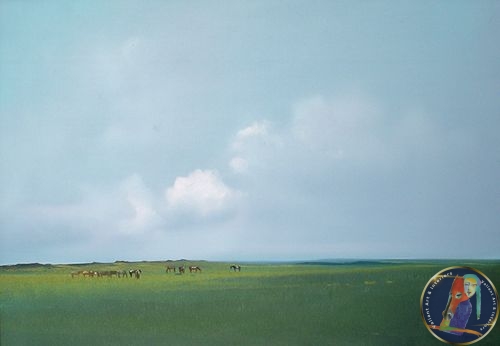
In this masterful display of photorealism and figurative landscape, Khurelbaatar Choindon captures a serene yet powerful moment on the Mongolian steppe. The composition is horizontally oriented, emphasizing the vast, rhythmic expanse of the high-altitude grasslands that define the artist’s homeland.
The Subjects: Twelve Horses
The twelve horses are the focal point, rendered with the anatomical precision characteristic of Choindon’s training at the Repin Academy of Fine Art. Rather than a frantic gallop, the horses are depicted in a state of natural grace—some grazing, others standing alert, their muscular frames subtly highlighted by a soft, directional light.
The artist utilizes a diverse palette for the horses’ coats:
Earth tones: Deep chestnuts, warm bays, and rich sorrels.
Contrast: A few white or dappled-grey horses provide visual “anchors” within the group, breaking the continuity of the darker tones.
Detail: The texture of the manes and tails appears fine and wind-swept, suggesting a gentle breeze moving across the plateau.
The Setting: The Green Steppe
The “Green Steppe” of the title is not a flat wash of color, but a complex tapestry of verdant hues. Choindon employs Realism to showcase the varied topography of the Mongolian landscape:
Foreground: Short, dense tufts of summer grass are painted with individual clarity, grounding the animals in their environment.
Midground: The rolling hills create soft undulations, using atmospheric perspective to transition from vibrant emeralds to muted, hazy teals.
Atmosphere: The vast sky likely occupies the upper third of the canvas, painted with a clarity that suggests the thin, crisp air of Mongolia. The light is diffused, avoiding harsh shadows and instead bathing the scene in a tranquil, timeless glow.
Artistic Context
Created in 2006, this work represents the height of Choindon’s technical prowess. By blending his Mongolian heritage (College of Fine Art, Ulaanbaatar) with Russian academic rigor (St. Petersburg), he elevates a traditional nomadic scene into a sophisticated study of light and form.
The painting serves as more than a landscape; it is a cultural portrait. The number twelve often carries significance in Central Asian traditions, and the harmony between the herd and the steppe reflects the deep-seated Mongolian reverence for nature and the equine spirit.
