

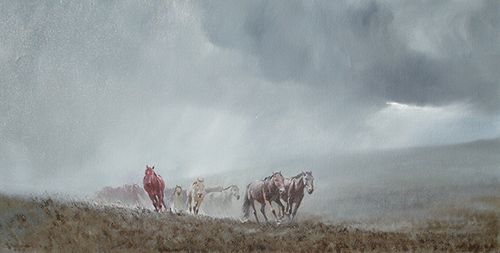
The painting utilizes an elongated horizontal format (46 x 93 cm), a choice that mirrors the vast, unending horizons of the Mongolian steppe. This wide-angle perspective allows the artist to create a literal and symbolic parallel between the curves of the human form and the undulating lines of the earth.
The Landscape
The setting is a landscape of profound quietude. Under a sky heavy with the “fine rain” suggested by the title, the Mongolian steppe is rendered in a palette of muted greens, soft ochres, and cool grays.
Atmosphere: There is a palpable sense of moisture in the air. Dash uses thin, translucent layers of oil to create a diffused, silvery light that softens the edges of the distant hills.
Realism: Drawing from his rigorous training at the Repin Academy of Arts, Dash treats the grass and earth with meticulous detail, yet he avoids clinical coldness, opting instead for a poetic, lived-in realism.
The Figurative Subject
Central to the composition is a nude female figure, reclining with a grace that suggests she is an extension of the land itself.
Anatomy: The figure is rendered with the anatomical precision characteristic of the Russian Academic tradition. Every subtle shift in muscle and bone is accounted for, yet the skin has a luminous, pearlescent quality that makes her appear almost ethereal against the damp earth.
Integration: Her pose follows the natural topography of the background hills. The curve of a hip mimics a distant ridge; the slope of a shoulder reflects the gentle decline of a valley. This creates a powerful thematic link between femininity and Mother Nature (Etugen).
Color Palette and Technique
The color scheme is sophisticated and restrained, leaning into the “Zuser Boroo” theme:
Skin Tones: A blend of warm ivories and cool lavenders, capturing the way skin reacts to filtered, overcast sunlight.
Background: Earthy umbers and mossy greens that feel weighted and grounded.
Brushwork: Dash employs a “smooth” finish on the figure to emphasize the softness of the skin, contrasted with more textured, rhythmic brushstrokes in the foreground flora to suggest the dampness of the rain-soaked grass.
Mood and Interpretation
The painting evokes a sense of profound solitude and harmony. There is no tension in the figure’s pose; rather, there is a total surrender to the elements. By placing a nude figure in the center of a damp, vast landscape, Erdene Dash explores the vulnerability and the resilience of the human spirit. It is a celebration of the Mongolian identity—deeply rooted in the land, quiet in its strength, and beautiful in its simplicity.