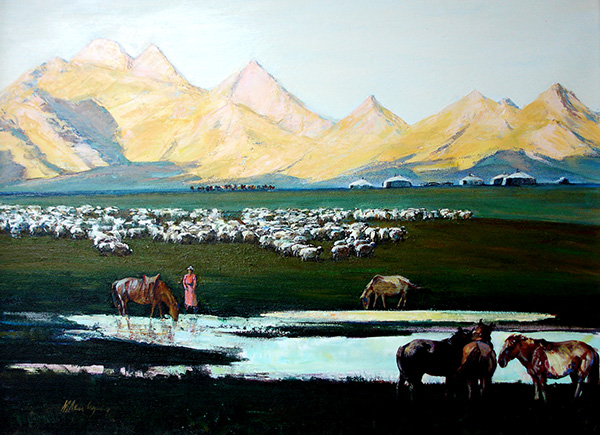
The painting is a rich and evocative landscape executed in Oil on canvas in 2006. The dimensions are given as $50 \times 70 \text{cm}$ or $19” \times 27”$.
Visual Description
The artwork beautifully captures a scene that speaks to the nomadic culture and vast landscapes of Mongolia.
-
Background: The upper portion is dominated by a range of majestic mountains. Their peaks are illuminated in a vivid yellow or golden hue by what appears to be strong sunlight, giving the painting its name “Yellow Mountain.” Below the peaks, the slopes are shadowed in deep blue and purple tones, suggesting depth and scale.
-
Middle Ground: The middle ground is an expanse of rich, dark green grassland. Across this plain, a large herd of white sheep is densely clustered, moving or grazing, emphasizing the livelihood of the region’s inhabitants. Scattered among the grasslands are several white gers (traditional Mongolian tents), indicating a nomadic encampment.
-
Foreground: The foreground is a scene of animal husbandry and daily life. It features a bright, reflective body of water or a low-lying marshy area.
-
To the left of the water, a solitary figure, the ‘Lady’, dressed in a traditional long, reddish robe, stands near two brown horses that are drinking from the water.
-
To the right, three more horses, primarily dark brown and a reddish-brown one, are clustered together on the dark earth, possibly resting or interacting.
-
The immediate foreground is composed of dark, almost black earth and shadows, contrasting sharply with the bright water and the yellow mountains in the distance.
-
Analysis
The painting employs a stark contrast between the luminous, golden peaks and the dark, deep greens and browns of the steppe. This contrast enhances the visual drama of the Mongolian landscape. The figures—the solitary woman and her clustered horses and sheep—are small against the colossal mountains, highlighting the traditional nomadic relationship with the immense and powerful natural world. It is a powerful illustration of the “Land of the Eternal Blue Sky,” showcasing the harmony between the people, their herds, and the magnificent, rugged environment.