
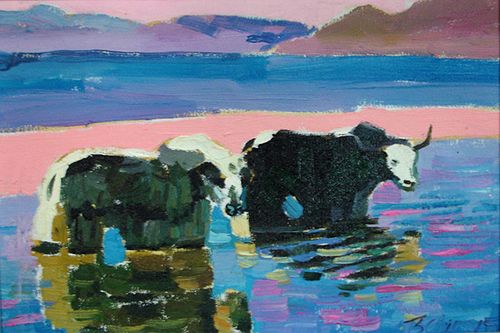
This 2007 work by Mongolian artist Chinggis Tulgabaatar is a masterclass in intimate photorealism. Despite its modest dimensions (25 x 30 cm), the painting commands a powerful presence, serving as both a biological record and a soulful tribute to a cornerstone of Central Asian nomadic life.
Visual Composition and Subject
In “Yak,” Tulgabaatar utilizes a tight, figurative portrait composition. By choosing a small canvas, the artist forces a close-up encounter between the viewer and the subject. The yak is not merely a figure in a distance; it is a monumental presence that fills the frame.
The Focal Point: The viewer’s eye is immediately drawn to the texture of the yak’s coat. Tulgabaatar’s technical precision allows for the rendering of individual, coarse guard hairs and the softer, dense undercoat—essential adaptations for the Mongolian climate.
The Gaze: As a “Portrait,” the work likely emphasizes the animal’s eye—often depicted with a liquid, stoic depth that reflects the vastness of the Mongolian landscape.
The Background: While categorized under “Landscape,” the 25 x 30 cm scale suggests the environment is treated with a soft-focus or minimalist approach, ensuring the “Nature” element supports rather than distracts from the animal itself.
Style and Technique
Tulgabaatar, born in Ulaanbaatar in 1985, belongs to a generation of Mongolian artists who bridge traditional nomadic themes with rigorous Photorealism.
Photorealism & Realism: The artist uses oil on canvas to achieve a high degree of luminosity. The interplay of light on the yak’s horns—perhaps showing the chips and ridges of age—demonstrates a commitment to “Realism” that avoids romanticization in favor of raw, honest observation.
Color Palette: Expect a grounded, earthy palette. Deep umbers, charcoal blacks, and ochres dominate the subject, potentially contrasted against the muted, high-altitude blues or dusty golds of the Mongolian steppe.
Context and Symbolism
Created when the artist was 22, this piece reflects an early mastery of the “Figurative Art” style. In the Mongolian context, the yak is more than livestock; it is a symbol of resilience, warmth, and survival. By treating the animal with the formal dignity of a human portrait, Tulgabaatar elevates the yak from a domestic beast to a silent protagonist of the wilderness.
Note on Scale: At 25 x 30 cm, this painting functions like a “cabinet painting”—an artwork intended to be viewed from a short distance, inviting the observer to appreciate the microscopic brushwork and the tangible “weight” of the oil medium.