Tugaltai Huuhed

Batjargal Tseintsogzol , 2007 , Oil On Canvas

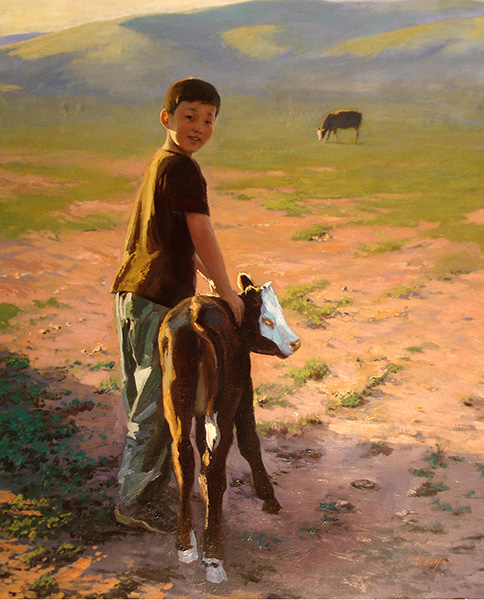
Tugaltai Huuhed, painted by the late Mongolian master Batjargal Tseintsogzol, is a poignant example of contemporary Mongolian Photorealism. The title translates roughly to “Child with Calf,” a theme that sits at the very heart of nomadic Mongolian culture. In this 2007 masterpiece, Tseintsogzol elevates a mundane moment of rural life into a cinematic, hyper-detailed exploration of innocence, heritage, and the bond between humans and animals.

Visual Description & Style

The painting captures a young child in traditional attire, cradling or standing beside a calf. Tseintsogzol’s mastery of Realism is evident in the tactile rendering of textures:

  • The Subject: The child’s face is rendered with breathtaking precision, capturing the weathered yet soft complexion typical of youth spent in the high-altitude Mongolian steppe. The eyes often serve as the focal point, reflecting a quiet, soulful depth.

  • Textural Contrast: There is a brilliant juxtaposition between the rough, matted fur of the calf and the intricate patterns of the child’s deel (traditional tunic). The artist uses micro-brushwork to define individual hairs and the subtle play of light on silk or wool.

  • Lighting and Atmosphere: Tseintsogzol employs a naturalistic light source, likely mimicking the harsh yet golden “magic hour” of the steppe. This creates high-contrast shadows that give the figures a three-dimensional, sculptural quality against a soft, often blurred (bokeh-style) background.

Cultural Significance

As a prominent figure in the Ulaanbaatar art scene, Tseintsogzol was known for documenting the disappearing nuances of nomadic life. In Tugaltai Huuhed, the calf is not merely livestock; it represents the livelihood and the spiritual companion of the Mongol people. The painting functions as both a technical feat of Photorealism and a nostalgic preservation of a way of life that remains central to Mongolian identity.

Legacy of the Artist

Batjargal Tseintsogzol (1966–2020) was celebrated for his ability to breathe life into canvas. His work often transcended simple “copying” of reality, instead infusing his subjects with a dignity and stillness that felt almost spiritual. Tugaltai Huuhed remains one of his definitive works, showcasing his dedication to capturing the raw, unvarnished beauty of his homeland.
  • Batjargal Tseintsogzol
  • Photorealism, Realism
  • Oil On Canvas
  • BTJ8/036
  • 91 x 73cm

Add Your Comment

Mongolian Art Gallery © 2025. All Rights Reserved
Privacy Policy / Terms of Use

Tugaltai Huuhed, painted by the late Mongolian master Batjargal Tseintsogzol, is a poignant example of contemporary Mongolian Photorealism. The title translates roughly to “Child with Calf,” a theme that sits at the very heart of nomadic Mongolian culture. In this 2007 masterpiece, Tseintsogzol elevates a mundane moment of rural life into a cinematic, hyper-detailed exploration of innocence, heritage, and the bond between humans and animals.

Visual Description & Style

The painting captures a young child in traditional attire, cradling or standing beside a calf. Tseintsogzol’s mastery of Realism is evident in the tactile rendering of textures:

  • The Subject: The child’s face is rendered with breathtaking precision, capturing the weathered yet soft complexion typical of youth spent in the high-altitude Mongolian steppe. The eyes often serve as the focal point, reflecting a quiet, soulful depth.

  • Textural Contrast: There is a brilliant juxtaposition between the rough, matted fur of the calf and the intricate patterns of the child’s deel (traditional tunic). The artist uses micro-brushwork to define individual hairs and the subtle play of light on silk or wool.

  • Lighting and Atmosphere: Tseintsogzol employs a naturalistic light source, likely mimicking the harsh yet golden “magic hour” of the steppe. This creates high-contrast shadows that give the figures a three-dimensional, sculptural quality against a soft, often blurred (bokeh-style) background.

Cultural Significance

As a prominent figure in the Ulaanbaatar art scene, Tseintsogzol was known for documenting the disappearing nuances of nomadic life. In Tugaltai Huuhed, the calf is not merely livestock; it represents the livelihood and the spiritual companion of the Mongol people. The painting functions as both a technical feat of Photorealism and a nostalgic preservation of a way of life that remains central to Mongolian identity.

Legacy of the Artist

Batjargal Tseintsogzol (1966–2020) was celebrated for his ability to breathe life into canvas. His work often transcended simple “copying” of reality, instead infusing his subjects with a dignity and stillness that felt almost spiritual. Tugaltai Huuhed remains one of his definitive works, showcasing his dedication to capturing the raw, unvarnished beauty of his homeland.