
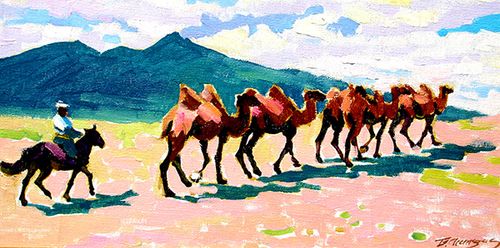
Tranfort is a compelling oil-on-canvas work by Mongolian artist Chinggis Tulgabaatar. Completed in 2007, when the artist was 22 years old, this piece stands as a testament to his early mastery of Photorealism and Realism. Despite its relatively intimate dimensions of 23 x 43 cm, the painting captures a vast sense of atmosphere and technical precision.
Visual Analysis
The painting is a sophisticated blend of Figurative Art and Landscape, likely exploring the intersection of human presence and the natural world—a recurring theme in Mongolian contemporary art. Tulgabaatar’s technique utilizes the slow-drying nature of oil paint to create seamless gradients and razor-sharp details that define the Photorealist style.
Composition: The horizontal orientation (23 x 43 cm) suggests a panoramic view, ideal for capturing the expansive horizons of the Mongolian steppe or a detailed, cinematic figurative scene.
Style & Technique: As a work of Realism, Tranfort shuns abstraction in favor of an objective, almost “lens-like” depiction of its subject. The brushwork is likely invisible, creating a smooth surface where light and texture—whether the softness of skin in a Portrait or the ruggedness of Nature—are rendered with startling accuracy.
Thematic Depth: The title, Tranfort, suggests a state of transition or “transport,” perhaps referencing the movement between the traditional nomadic lifestyle and the modern urban reality of Ulaanbaatar.
About the Artist: Chinggis Tulgabaatar
Born in Ulaanbaatar in 1985, Chinggis Tulgabaatar belongs to a generation of Mongolian artists who bridge the gap between classical academic training and contemporary global styles.
Artistic Evolution: By the time he painted Tranfort in 2007, Tulgabaatar was already establishing himself as a virtuoso of form. His work often oscillates between the sweeping scale of Landscapes and the intimate psychological depth of Portraits.
Influence: His style is deeply rooted in the observation of reality. By focusing on Photorealism, he challenges the viewer to look closer at the mundane or the majestic, capturing moments of Mongolian life with a clarity that feels both timeless and modern.