

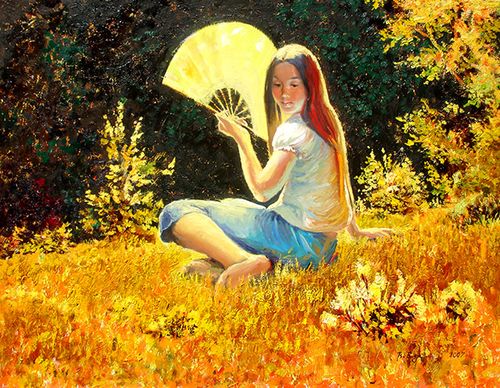
Sunny Day is a masterful example of Mongolian Photorealism, capturing a fleeting moment of atmospheric clarity. Painted in 2007, this oil-on-canvas work ($70 \times 90$ cm) reflects Batjargal Tseintsogzol’s profound connection to the natural light and expansive landscapes of his homeland.
Visual Analysis
Light and Atmosphere: True to its title, the painting is defined by a high-contrast play of light. Tseintsogzol uses the Photorealist technique to render the “white light” characteristic of high-altitude Mongolian plateaus. The sun isn’t just a source of visibility; it is a physical presence that flattens certain textures while bringing others into sharp, crystalline focus.
Composition: The $70 \times 90$ cm dimensions offer a wide-angle perspective that emphasizes the vastness of the scene. Whether depicting the rolling steppes or a quiet rural corner, the artist employs a rigorous sense of depth, leading the viewer’s eye from a meticulously detailed foreground toward a soft, hazy horizon.
Technical Precision: As a practitioner of Realism, Tseintsogzol’s brushwork is virtually invisible. The oil medium is layered to mimic the organic textures of grass, earth, or sky with such accuracy that the painting initially mimics a high-resolution photograph. However, upon closer inspection, the “soul” of the painting emerges through the artist’s ability to capture the specific warmth of the sun—a feat of color temperature that digital sensors often miss.
Context and Style
Born in Ulaanbaatar, Tseintsogzol was a pivotal figure in modern Mongolian art, bridging the gap between traditional appreciation for nature and the precision of contemporary Realism.
Photorealism & Nature: In Sunny Day, nature is not romanticized or abstracted; it is presented with “objective” honesty. This style allows the viewer to experience the Mongolian landscape as it truly is—rugged, quiet, and bathed in an unforgiving yet beautiful light.
Legacy: Created during the peak of his career, this work serves as a testament to Tseintsogzol’s technical discipline and his lifelong dedication to documenting the shifting light of the North Asian landscape before his passing in 2020.
Note: The painting stands as a bridge between the observer and the environment, inviting a meditative appreciation for the stillness of a bright afternoon.