
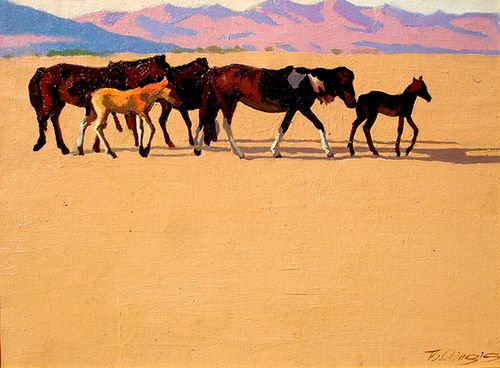
Steppe Horses (2007) is a masterclass in modern Mongolian realism, captured by the then-22-year-old Chinggis Tulgabaatar. Despite its modest dimensions ($30 \times 40 \text{ cm}$), the painting carries the immense weight and spirit of the Central Asian wilderness.
Here is a detailed breakdown of the work:
1. Composition and Subject Matter
The painting centers on a small group of Mongolian horses, animals that are not just livestock but cultural icons of the Mongol identity. Tulgabaatar employs Figurative Art techniques to emphasize the horses’ powerful musculature and sturdy build—traits developed through centuries of surviving the harsh continental climate.
The Focal Point: Usually, one or two horses are positioned in the foreground or mid-ground, their forms rendered with such precision that they appear three-dimensional.
Perspective: The artist often uses a low-angle perspective, making the horses appear noble and monumental against the vast horizon of the steppe.
2. Technique: Photorealism and Texture
As a practitioner of Photorealism, Tulgabaatar’s technical execution is nearly indistinguishable from a high-resolution photograph.
The Coats: You can almost feel the texture of the horses’ winter coats—coarse, thick, and matted in places, yet reflecting the soft light of the Mongolian sun.
The Eyes: A hallmark of his style is the “liquid” quality of the horses’ eyes, which often reflect the surrounding landscape, giving the animals a sense of deep, silent consciousness.
Detailing: From the frayed edges of a mane to the individual blades of dry, golden grass at their hooves, no detail is overlooked.
3. The Landscape and Light
The “Steppe” in the title is more than just a background; it is a character in itself.
The Palette: Tulgabaatar utilizes a naturalistic palette of ochres, burnt sienna, and muted greens to represent the rugged terrain. These are often contrasted with the “Eternal Blue Sky” ($Mönkh \ Khökh \ Tenger$) that is central to Mongolian spirituality.
Lighting: The 2007 piece likely utilizes “Golden Hour” lighting—long, soft shadows and a warm glow that highlights the contours of the horses’ bodies, creating a serene, almost nostalgic atmosphere.
4. Artistic Context
Born in Ulaanbaatar in 1985, Tulgabaatar represents a generation of Mongolian artists who bridge the gap between traditional nomadic subjects and contemporary Western academic techniques. Steppe Horses is a reflection of this bridge:
Realism: It honors the physical reality of the horse.
Nature: It celebrates the unyielding beauty of the Mongolian environment.
Portraiture: It treats the horse not as a beast of burden, but as an individual subject worthy of a formal portrait.