
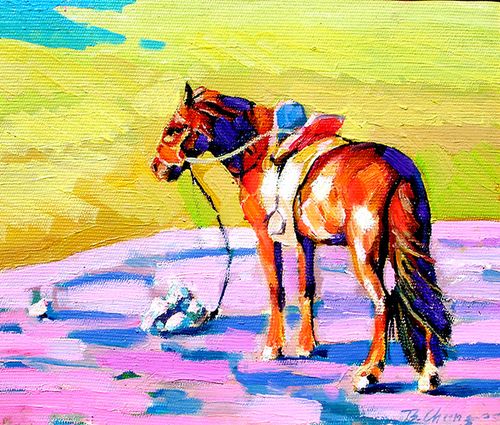
This painting by Chinggis Tulgabaatar is a masterful study of light and texture, showcasing the artist’s deep connection to his Mongolian heritage through the lens of meticulous photorealism. Despite its intimate size (25 x 30cm), the work carries the weight and dignity of the vast Mongolian steppe.
Visual Composition & Style
The painting, titled Single Horse 1, is a prime example of Photorealism and Figurative Art. The horse is not merely a subject but is treated with the reverence of a human Portrait.
Subject Focus: The horse is positioned centrally, captured in a moment of quiet stillness. Tulgabaatar avoids the cliché of a horse in full gallop, opting instead for a “psychological” portrait that emphasizes the animal’s temperament and presence.
Texture and Detail: Using oil on canvas, the artist achieves a startling level of detail. You can almost feel the coarseness of the mane, the velvet-like texture of the muzzle, and the subtle ripple of muscle beneath the coat.
Lighting: The light source is soft yet directional, highlighting the anatomical precision of the horse’s frame and creating a sense of three-dimensional depth against the background.
Landscape & Atmosphere
While the horse is the focal point, the Landscape plays a crucial role in establishing the mood.
The Mongolian Steppe: The background likely hints at the expansive, rolling hills of Mongolia. The palette is grounded in earthy, natural tones—ochres, muted greens, and soft browns—which ground the piece in Realism.
Atmospheric Perspective: There is a sense of “Nature” that feels both wild and serene. The background is often slightly softened to ensure the viewer’s eye remains locked on the intricate details of the horse.
Artist Context: Chinggis Tulgabaatar
Born in 1985 in Ulaanbaatar, Tulgabaatar belongs to a generation of Mongolian artists who blend traditional nomadic subjects with modern, high-fidelity techniques.
Cultural Significance: In Mongolia, the horse is a symbol of spirit and freedom. By applying a Western photorealistic style to this ancient symbol, Tulgabaatar bridges the gap between traditional Mongolian identity and contemporary global art movements.
Technical Skill: His ability to render life-like subjects at such a small scale (25 x 30cm) demonstrates incredible brush control and a disciplined “slow art” approach.