
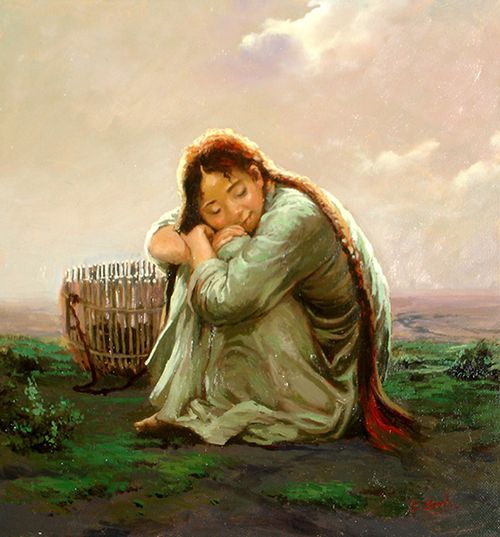
Short Nap is an exquisite example of Mongolian photorealism, captured by the late Batjargal Tseintsogzol. At a modest $45 \times 45\text{cm}$, this oil-on-canvas work draws the viewer into a moment of profound, quiet intimacy that transcends its physical dimensions.
Artistic Composition and Style
Tseintsogzol was a master of capturing the “soul” of the Mongolian landscape and its inhabitants. In this piece, his background in Photorealism and Nature is on full display. Rather than a sweeping, epic vista, the artist focuses on the micro-details of a momentary rest.
Technique: The brushwork is incredibly fine, rendering textures—be it the coarse wool of a garment, the soft pelt of an animal, or the weathered skin of a subject—with such precision that they appear tactile.
Lighting: The painting likely utilizes the soft, diffused light characteristic of the Mongolian steppe, casting gentle shadows that emphasize the stillness of the “nap.“
Atmosphere: There is a signature “Tseintsogzol” stillness here. The work doesn’t just depict a lack of movement; it evokes a deep sense of peace and the symbiotic relationship between humans and the natural world.
Cultural Context
Born in Ulaanbaatar, Tseintsogzol’s work often serves as a bridge between traditional nomadic life and contemporary realist techniques. Short Nap likely features subjects central to Mongolian identity—perhaps a herder or a livestock animal—resting in a way that feels both fleeting and eternal. In the context of the harsh Mongolian climate, a “short nap” is not just a break; it is a vital moment of recovery and harmony with the environment.