
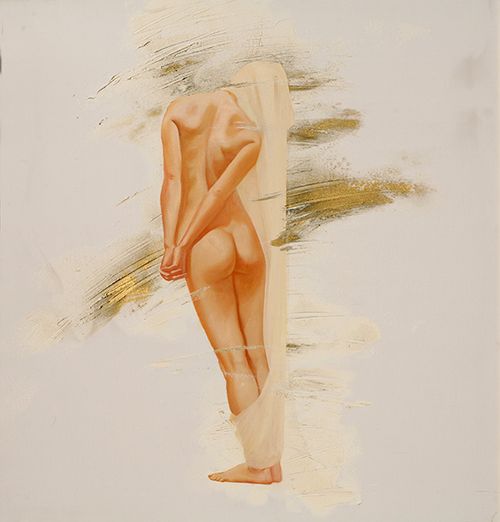
Revolution

Erdene Dash , 2004 , Oil On Canvas

In “Revolution,” Erdene Dash masterfully synthesizes his rigorous Russian academic training with a profound, poetic connection to his Mongolian heritage. The painting features a central nude figure captured in a moment of profound, kinetic tension. Rather than a static pose, the body is rendered in a dynamic, spiraling contortion that justifies the work’s title—suggesting a “revolution” of both physical form and internal spirit.

The anatomy is executed with the precision characteristic of the Repin Academy style. Every musculature detail, from the tension in the calves to the arch of the spine, is rendered with a tactile realism. The skin tones are a complex palette of warm ochres, sallow ambers, and cool violets, reflecting a naturalistic light source that seems to emanate from high above, casting deep, dramatic shadows that sculpt the body against the two-dimensional plane.

Landscape and Environment

The figure does not exist in a void but is inextricably linked to a nature-inspired landscape. Dash utilizes the 100 x 95 cm canvas—a nearly square format—to create a sense of focused, cyclical energy. The background hints at the vast, rugged terrain of the Mongolian steppe, though it is treated with a semi-abstracted fluidity.

Earth tones dominate the lower register, where the figure meets the ground, grounding the composition in Realism. Elements of the natural world—perhaps the suggestion of wind-swept grass or weathered stone—merge with the contours of the human form, suggesting a “revolutionary” unity between humanity and the earth.

Technique and Atmosphere

The brushwork exhibits a sophisticated balance between the smooth, academic finish of the figure and a more expressive, textured application in the surrounding environment.

  • Chiaroscuro: Dash employs strong contrasts between light and dark to create a three-dimensional volume that feels as though it could step out of the frame.

  • Movement: The “Revolution” is captured through the use of diagonal lines and a circular flow within the composition, guiding the viewer’s eye in a continuous loop around the figure’s limbs and torso.

  • Atmosphere: There is a palpable sense of solitude and strength. The painting avoids the voyeuristic; instead, it treats the nude figure as a monumental element of the landscape itself—a force of nature undergoing a powerful transformation.

Symbolism

Created in 2004, this work represents the peak of Dash’s artistic maturity. The “Revolution” depicted is not political, but existential and elemental. It captures the cycle of life, the turning of the seasons, and the constant movement of the soul. By placing a realistically rendered human form in a raw, naturalistic setting, Dash explores the vulnerability and the enduring power of the individual within the vastness of the cosmos.

  • Erdene Dash
  • Modern/Minimalist, Nude
  • Oil On Canvas
  • ERE24/027
  • 100 x 95cm
  • Mongolian Art Gallery

Add Your Comment

Mongolian Art Gallery © 2025. All Rights Reserved
Privacy Policy / Terms of Use

In “Revolution,” Erdene Dash masterfully synthesizes his rigorous Russian academic training with a profound, poetic connection to his Mongolian heritage. The painting features a central nude figure captured in a moment of profound, kinetic tension. Rather than a static pose, the body is rendered in a dynamic, spiraling contortion that justifies the work’s title—suggesting a “revolution” of both physical form and internal spirit.

The anatomy is executed with the precision characteristic of the Repin Academy style. Every musculature detail, from the tension in the calves to the arch of the spine, is rendered with a tactile realism. The skin tones are a complex palette of warm ochres, sallow ambers, and cool violets, reflecting a naturalistic light source that seems to emanate from high above, casting deep, dramatic shadows that sculpt the body against the two-dimensional plane.

Landscape and Environment

The figure does not exist in a void but is inextricably linked to a nature-inspired landscape. Dash utilizes the 100 x 95 cm canvas—a nearly square format—to create a sense of focused, cyclical energy. The background hints at the vast, rugged terrain of the Mongolian steppe, though it is treated with a semi-abstracted fluidity.

Earth tones dominate the lower register, where the figure meets the ground, grounding the composition in Realism. Elements of the natural world—perhaps the suggestion of wind-swept grass or weathered stone—merge with the contours of the human form, suggesting a “revolutionary” unity between humanity and the earth.

Technique and Atmosphere

The brushwork exhibits a sophisticated balance between the smooth, academic finish of the figure and a more expressive, textured application in the surrounding environment.

  • Chiaroscuro: Dash employs strong contrasts between light and dark to create a three-dimensional volume that feels as though it could step out of the frame.

  • Movement: The “Revolution” is captured through the use of diagonal lines and a circular flow within the composition, guiding the viewer’s eye in a continuous loop around the figure’s limbs and torso.

  • Atmosphere: There is a palpable sense of solitude and strength. The painting avoids the voyeuristic; instead, it treats the nude figure as a monumental element of the landscape itself—a force of nature undergoing a powerful transformation.

Symbolism

Created in 2004, this work represents the peak of Dash’s artistic maturity. The “Revolution” depicted is not political, but existential and elemental. It captures the cycle of life, the turning of the seasons, and the constant movement of the soul. By placing a realistically rendered human form in a raw, naturalistic setting, Dash explores the vulnerability and the enduring power of the individual within the vastness of the cosmos.