

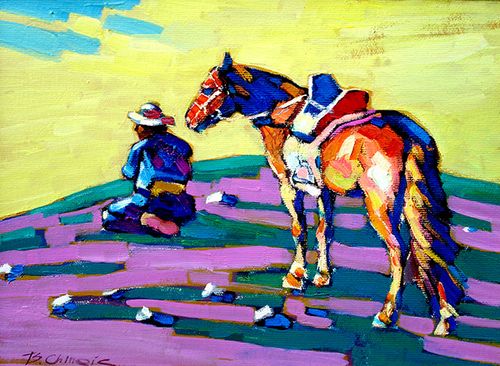
This painting, titled “Mountain” (2006), is a compelling early work by the Mongolian contemporary artist Chinggis Tulgabaatar. Executed in oil on a modest $30 \times 40\text{ cm}$ canvas, the piece serves as a masterclass in the intersection of Photorealism and the rugged, spiritual essence of the Mongolian landscape.
Visual Composition and Style
While Tulgabaatar is often celebrated for his figurative work and portraits, “Mountain” demonstrates his profound connection to Nature and Landscape art.
Technique: Utilizing the meticulous precision of Photorealism, the artist captures the tactile reality of geological formations. Every fissure in the rock and the subtle gradation of light hitting the peaks is rendered with such clarity that the oil medium almost mimics the high resolution of a photograph.
Perspective: The composition likely focuses on a singular, dominant peak or a specific ridge line, emphasizing the isolation and monumental scale of the Mongolian wilderness, even within a relatively small frame.
Artistic Context and Influence
Born in 1985 in Ulaanbaatar, Tulgabaatar was roughly 21 years old when he completed this piece. This stage of his career reflects a technical mastery of Realism that honors the traditions of Mongolian academic painting while leaning into a modern, hyper-focused aesthetic.
Cultural Connection: In Mongolian culture, mountains are often revered as sacred entities. Through a Figurative Art lens—treating the mountain almost as a “portrait” of a living being—Tulgabaatar imbues the stone and snow with a sense of character and stoic endurance.
The Palette: Given the artist’s style, the color palette likely favors desaturated earth tones—ochres, deep grays, and brilliant whites—contrasted against the sharp, piercing blue of a high-altitude sky.
