
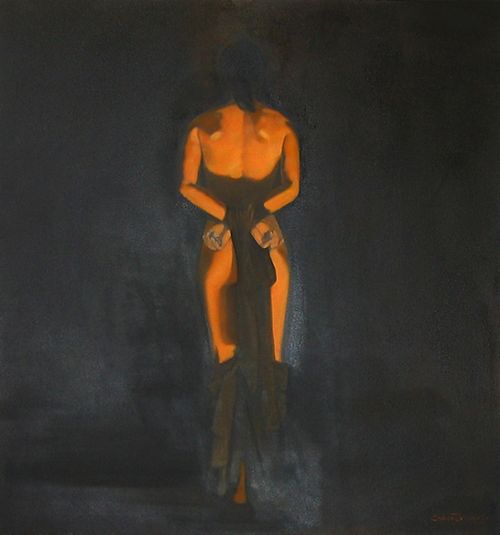
Melancholia

Erdene Dash , 2005 , Oil On Canvas

At the heart of the 100 x 95 cm canvas is a solitary, nude female figure, positioned slightly off-center. She is rendered with the exacting anatomical precision characteristic of Dash’s rigorous classical training in Russia. The figure sits upon a weathered, moss-draped outcrop of stone, her posture folded inward in a classic pose of deep introspection. Her knees are drawn toward her chest, and her face is partially obscured by her arms and loose, dark hair that falls forward. The pale, luminous quality of her skin creates a striking sense of vulnerability, contrasting sharply with the rugged, textured environment around her.

The Landscape and Atmosphere The surrounding environment is not merely a backdrop but an active participant in the painting’s emotional weight, heavily inspired by Dash’s Mongolian roots. The landscape stretches out behind the figure into a vast, desolate steppe, eventually giving way to rolling, misty foothills in the deep background. The flora is sparse and autumnal; brittle, dry grasses and low-lying shrubs frame the rock she sits on. Above, the sky is a heavy, overcast expanse of layered slate and ash-gray clouds. The atmosphere appears perfectly still—almost suffocatingly quiet—mirroring the internal psychological state of the subject.

Color Palette and Lighting Dash employs a subdued, melancholic palette dominated by cool grays, deep forest greens, and warm, earthy ochres. The lighting is diffused and shadowless, replicating the heavy, muted light of an overcast afternoon or the fading moments of twilight. Rather than harsh, dramatic contrasts, the light wraps around the nude figure in a soft, silvery luminescence, highlighting the subtle contours of her back and shoulders while allowing the edges of the landscape to sink into shadow.

Technique and Artistic Influence The brushwork bridges the gap between the academic realism of the Surikov and Repin Academies and a deeply personal connection to nature. The figure is painted with deliberate, smooth, and highly detailed strokes, creating a tangible sense of flesh and weight. In contrast, the natural elements—the rough rocks, the sweeping grasses, and the distant mountains—are treated with slightly looser, more expressive brushwork. This shift in texture keeps the viewer’s eye anchored to the human element while conveying the raw, untamed beauty of the outdoors.

Emotional Resonance True to its title, Melancholia is a profound exploration of human frailty, isolation, and quiet sorrow. By placing an exposed, highly realistic human form directly into the elements of a vast, indifferent landscape, Erdene Dash masterfully captures the intersection of nature and the human psyche, leaving the viewer with a lingering sense of beautiful, quiet grief.

  • Erdene Dash
  • Geometric, Portrait
  • Oil On Canvas
  • ERE24/034
  • 100 x 95cm
  • Mongolian Art Gallery

Add Your Comment

Mongolian Art Gallery © 2025. All Rights Reserved
Privacy Policy / Terms of Use

At the heart of the 100 x 95 cm canvas is a solitary, nude female figure, positioned slightly off-center. She is rendered with the exacting anatomical precision characteristic of Dash’s rigorous classical training in Russia. The figure sits upon a weathered, moss-draped outcrop of stone, her posture folded inward in a classic pose of deep introspection. Her knees are drawn toward her chest, and her face is partially obscured by her arms and loose, dark hair that falls forward. The pale, luminous quality of her skin creates a striking sense of vulnerability, contrasting sharply with the rugged, textured environment around her.

The Landscape and Atmosphere The surrounding environment is not merely a backdrop but an active participant in the painting’s emotional weight, heavily inspired by Dash’s Mongolian roots. The landscape stretches out behind the figure into a vast, desolate steppe, eventually giving way to rolling, misty foothills in the deep background. The flora is sparse and autumnal; brittle, dry grasses and low-lying shrubs frame the rock she sits on. Above, the sky is a heavy, overcast expanse of layered slate and ash-gray clouds. The atmosphere appears perfectly still—almost suffocatingly quiet—mirroring the internal psychological state of the subject.

Color Palette and Lighting Dash employs a subdued, melancholic palette dominated by cool grays, deep forest greens, and warm, earthy ochres. The lighting is diffused and shadowless, replicating the heavy, muted light of an overcast afternoon or the fading moments of twilight. Rather than harsh, dramatic contrasts, the light wraps around the nude figure in a soft, silvery luminescence, highlighting the subtle contours of her back and shoulders while allowing the edges of the landscape to sink into shadow.

Technique and Artistic Influence The brushwork bridges the gap between the academic realism of the Surikov and Repin Academies and a deeply personal connection to nature. The figure is painted with deliberate, smooth, and highly detailed strokes, creating a tangible sense of flesh and weight. In contrast, the natural elements—the rough rocks, the sweeping grasses, and the distant mountains—are treated with slightly looser, more expressive brushwork. This shift in texture keeps the viewer’s eye anchored to the human element while conveying the raw, untamed beauty of the outdoors.

Emotional Resonance True to its title, Melancholia is a profound exploration of human frailty, isolation, and quiet sorrow. By placing an exposed, highly realistic human form directly into the elements of a vast, indifferent landscape, Erdene Dash masterfully captures the intersection of nature and the human psyche, leaving the viewer with a lingering sense of beautiful, quiet grief.