Visual Description
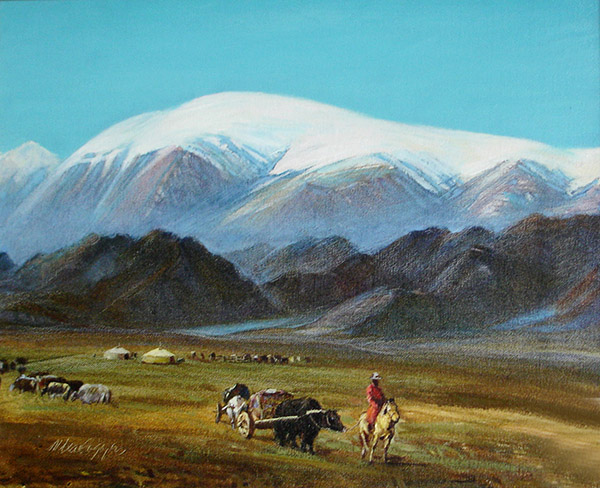
The painting captures a scene of quiet determination and survival in the imposing high country of Mongolia, likely the Altai or Khangai Mountains.
The Landscape
The backdrop is dominated by a majestic, snow-capped mountain range that stretches across the entire upper portion of the canvas.
-
Sky and Peaks: The sky is a brilliant, clear azure blue, contrasting sharply with the dazzling white snow of the distant peaks. The mountains beneath the snow are rendered in deep, cool hues of indigo, violet, and deep blue, conveying their immense size and the crisp, cold air of the altitude.
-
Valley Floor: The foreground consists of a grassy, earthy plain painted in warmer greens and browns, which grounds the scene and provides a contrast to the cool tones of the sky and mountains.
The Subjects
The central figures illustrate the specialized logistics of Mongolian herding in rugged terrain:
-
The Herder and Horse: A solitary herder, mounted on a horse, is positioned in the lower center. The horse is the symbol of speed and command.
-
The Yak: Following the horse is a pack yak, an animal essential for transporting heavy loads in the mountains due to its strength and tolerance for cold and high elevation. The yak is visibly laden with supplies, indicating the herder is either moving camp or bringing goods to the nearby settlement.
-
The Camp: In the distance of the valley, a scattering of white gers (yurts) and a small herd of grazing livestock provide context, confirming the scene is set near a traditional nomadic camp.
Thematic Significance
This painting, along with “Sheep and Camels” (LHD69/008), “Mountain” (LHD69/009), and “Running Horse” (LHD69/010), beautifully encapsulates the four major geographical and cultural environments of Mongolia: the Gobi Desert (camels), the Steppe (running horses), and the High Mountains (yaks and snow). It is a testament to the resilience and deep connection of the nomadic people to their varied homeland.