Horses

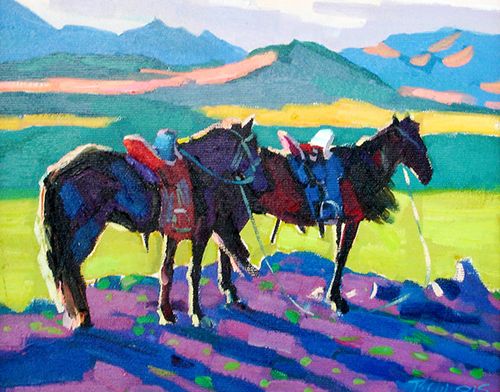
Chinggis Tulgabaatar , 2006 , Oil On Canvas

In Horses (2006), Chinggis Tulgabaatar delivers a masterclass in modern Mongolian Realism, capturing the raw vitality of the nation’s most iconic symbol. Despite the modest dimensions of the canvas (30 x 40 cm), the work possesses a monumental quality, bridging the gap between traditional pastoral life and technical Photorealism.

Visual Composition and Style

Tulgabaatar utilizes a Figurative approach to ground the subjects in a tangible reality. The painting likely focuses on a small cluster or a singular pair of horses, rendered with such precision that individual hairs, the moisture around the nostrils, and the muscular tension in the flanks are visible.

  • Landscape & Nature: The backdrop is not merely a setting but a character itself. It likely depicts the vast, undulating Mongolian steppe under a soft, diffused light, emphasizing the harmony between the animal and its environment.

  • Portraiture of the Animal: Unlike generic wildlife art, Tulgabaatar treats his subjects with the dignity of human Portraiture. There is a psychological depth in the horses’ eyes—an expression of stoic endurance and wild freedom that reflects the Mongolian spirit.

Technical Execution

Using oil on canvas, the artist employs a sophisticated layering technique to achieve a luminous finish.

  • Texture: The contrast between the sleek, oily sheen of the horses’ coats and the dry, wispy textures of the steppe grass creates a tactile experience.

  • Color Palette: Expect a grounded, earthy palette dominated by ochres, deep browns, and muted greens, punctuated by the sharp, realistic highlights of a “photorealistic” lens.

Artist Context: Chinggis Tulgabaatar

Born in 1985 in Ulaanbaatar, Tulgabaatar belongs to a generation of Mongolian artists who have refined academic realism into something deeply personal and culturally resonant. Having painted this at age 21, Horses represents an early peak in his ability to translate the heritage of his birthplace into a sophisticated, modern aesthetic.

Key takeaway: The painting is less a “picture of horses” and more an exploration of form and light, using the horse as a vessel to showcase the artist’s command over the physical world.
  • Chinggis Tulgabaatar
  • Photorealism, Sculpture
  • Oil On Canvas
  • CHI72/003
  • 30 x 40cm
  • Mongolian Art Gallery

Add Your Comment

Mongolian Art Gallery © 2025. All Rights Reserved
Privacy Policy / Terms of Use

In Horses (2006), Chinggis Tulgabaatar delivers a masterclass in modern Mongolian Realism, capturing the raw vitality of the nation’s most iconic symbol. Despite the modest dimensions of the canvas (30 x 40 cm), the work possesses a monumental quality, bridging the gap between traditional pastoral life and technical Photorealism.

Visual Composition and Style

Tulgabaatar utilizes a Figurative approach to ground the subjects in a tangible reality. The painting likely focuses on a small cluster or a singular pair of horses, rendered with such precision that individual hairs, the moisture around the nostrils, and the muscular tension in the flanks are visible.

  • Landscape & Nature: The backdrop is not merely a setting but a character itself. It likely depicts the vast, undulating Mongolian steppe under a soft, diffused light, emphasizing the harmony between the animal and its environment.

  • Portraiture of the Animal: Unlike generic wildlife art, Tulgabaatar treats his subjects with the dignity of human Portraiture. There is a psychological depth in the horses’ eyes—an expression of stoic endurance and wild freedom that reflects the Mongolian spirit.

Technical Execution

Using oil on canvas, the artist employs a sophisticated layering technique to achieve a luminous finish.

  • Texture: The contrast between the sleek, oily sheen of the horses’ coats and the dry, wispy textures of the steppe grass creates a tactile experience.

  • Color Palette: Expect a grounded, earthy palette dominated by ochres, deep browns, and muted greens, punctuated by the sharp, realistic highlights of a “photorealistic” lens.

Artist Context: Chinggis Tulgabaatar

Born in 1985 in Ulaanbaatar, Tulgabaatar belongs to a generation of Mongolian artists who have refined academic realism into something deeply personal and culturally resonant. Having painted this at age 21, Horses represents an early peak in his ability to translate the heritage of his birthplace into a sophisticated, modern aesthetic.

Key takeaway: The painting is less a “picture of horses” and more an exploration of form and light, using the horse as a vessel to showcase the artist’s command over the physical world.