
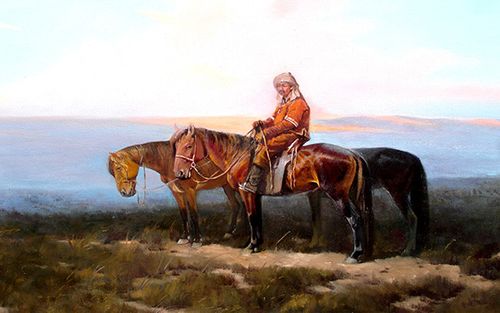
Horseman is a masterful oil-on-canvas composition that exemplifies Erdene Dash’s signature fusion of rigorous Russian academic realism and the primal, vast aesthetics of the Mongolian landscape. Measuring 50 x 100 cm, the painting utilizes a panoramic horizontal format to emphasize the sweeping scale of the environment and the rhythmic relationship between the subjects.
Composition and Subject Matter
The painting features a nude male figure mounted upon a horse, set against a backdrop of the expansive Mongolian steppe. By depicting the rider in the nude, Dash strips away temporal markers like clothing or modern gear, elevating the scene to a timeless, allegorical level. The composition is balanced yet dynamic; the horse and rider occupy a significant portion of the mid-ground, their forms rendered with the anatomical precision characteristic of Dash’s training at the Repin Academy of Arts.
The horizontal orientation of the canvas allows the eye to travel across the undulating horizon line, suggesting a world that extends far beyond the frame. This creates a sense of profound solitude and freedom, central to the nomadic spirit.
Technique and Realism
Dash employs Realism to articulate the physical textures of the scene:
The Figure: The musculature of the rider is rendered with subtle shifts in tone, capturing the tension and grace required to maintain balance. The skin reflects a naturalistic light, suggesting the warmth of the sun against the cool air of the highlands.
The Horse: The animal is portrayed with equal dignity. Dash captures the sheen of its coat, the strength in its neck, and the intelligent stillness of its posture. The horse is not merely a tool of transport but a primal extension of the rider himself.
The Landscape: The earth is painted with earthy ochres, muted greens, and sienna, while the sky occupies the upper third of the canvas, often rendered with soft, atmospheric gradients that suggest the clarity of high-altitude air.
Light and Atmosphere
The lighting in Horseman is evocative and directional, casting soft shadows that define the contours of both man and beast. There is a palpable sense of nature-inspired harmony; the figure does not dominate the landscape but exists as an integral part of it. The “Nude Art” element here is handled with a classical sensibility—focusing on the purity of form and the raw, unadorned connection between humanity and the natural world.
Artistic Significance
Created just two years before the artist’s passing, this work represents the pinnacle of Dash’s ability to translate the figurative traditions of Saint Petersburg into a uniquely Mongolian context. It is a contemplative piece that explores themes of:
Vulnerability and Strength: The exposure of the nude form against the elements.
Heritage: The ancestral link between the Mongolian people and the horse.
Unity: The seamless boundary between the human body and the wild terrain.