
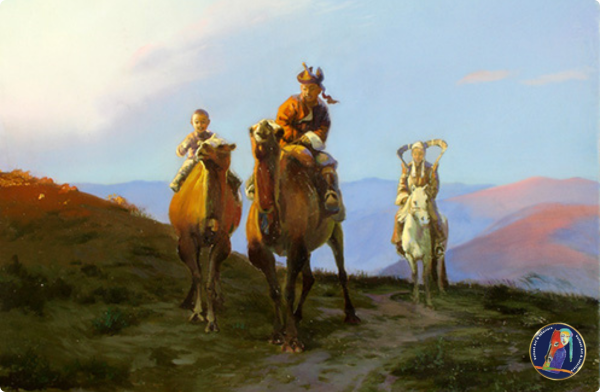
Happy Trio

Batjargal Tseintsogzol , 2007 , Oil On Canvas

The painting features three horses—likely the Przewalski’s horse (Takhi), native to the Mongolian steppes—positioned in a tight, affectionate cluster. True to the principles of Photorealism, Tseintsogzol captures the tactile reality of the scene with microscopic detail:

  • The Coats: The interplay of light on the horses’ short, muscular coats reveals a rich palette of ochre, dun, and creamy whites. Every individual hair and skin fold is rendered to create a sense of three-dimensional volume.

  • The Connection: The “Trio” of the title is expressed through their physical proximity; their necks overlap in a way that suggests familial bonding or mutual grooming, evoking a sense of calm and safety.

  • The Gaze: One horse looks directly toward the viewer with a glassy, lifelike eye that reflects the surrounding landscape, bridging the gap between the wild subject and the human observer.

Style and Technique

Tseintsogzol utilizes a shallow depth of field, a technique often borrowed from photography. While the horses are in sharp, crisp focus, the background—likely the expansive Mongolian grassland—is softened into a bokeh of muted greens and golds. This ensures that the viewer’s eye remains locked on the “Happy Trio,” highlighting the emotional weight of their interaction.

Despite the technical rigor of Realism, there is a soulful, almost atmospheric quality to the lighting. The soft, directional glow suggests the “golden hour” of a Mongolian late afternoon, bathing the subjects in a warmth that justifies the “Happy” in the title.


About the Artist: Batjargal Tseintsogzol (1966–2020)

Born in Ulaanbaatar, Tseintsogzol became one of Mongolia’s most respected contemporary realists. His work often served as a bridge between traditional Mongolian nomadic culture and modern technical excellence.

  • Cultural Context: In Mongolian culture, the horse is a sacred symbol of freedom and spirit. By applying a Photorealistic lens to these animals, Tseintsogzol elevates them from mere livestock to majestic, sentient beings worthy of portraiture.

     
  • Legacy: His untimely passing in 2020 left a void in the Central Asian art scene, but pieces like Happy Trio remain as a testament to his ability to find profound beauty in the stillness of nature.

“To look at a Tseintsogzol painting is not just to see an animal, but to feel the wind of the steppe and the warmth of the sun on its back.”

  • Batjargal Tseintsogzol
  • Photorealism, Realism
  • Oil On Canvas
  • BTJ8/007
  • 80 x 65cm

Add Your Comment

Mongolian Art Gallery © 2025. All Rights Reserved
Privacy Policy / Terms of Use

The painting features three horses—likely the Przewalski’s horse (Takhi), native to the Mongolian steppes—positioned in a tight, affectionate cluster. True to the principles of Photorealism, Tseintsogzol captures the tactile reality of the scene with microscopic detail:

  • The Coats: The interplay of light on the horses’ short, muscular coats reveals a rich palette of ochre, dun, and creamy whites. Every individual hair and skin fold is rendered to create a sense of three-dimensional volume.

  • The Connection: The “Trio” of the title is expressed through their physical proximity; their necks overlap in a way that suggests familial bonding or mutual grooming, evoking a sense of calm and safety.

  • The Gaze: One horse looks directly toward the viewer with a glassy, lifelike eye that reflects the surrounding landscape, bridging the gap between the wild subject and the human observer.

Style and Technique

Tseintsogzol utilizes a shallow depth of field, a technique often borrowed from photography. While the horses are in sharp, crisp focus, the background—likely the expansive Mongolian grassland—is softened into a bokeh of muted greens and golds. This ensures that the viewer’s eye remains locked on the “Happy Trio,” highlighting the emotional weight of their interaction.

Despite the technical rigor of Realism, there is a soulful, almost atmospheric quality to the lighting. The soft, directional glow suggests the “golden hour” of a Mongolian late afternoon, bathing the subjects in a warmth that justifies the “Happy” in the title.


About the Artist: Batjargal Tseintsogzol (1966–2020)

Born in Ulaanbaatar, Tseintsogzol became one of Mongolia’s most respected contemporary realists. His work often served as a bridge between traditional Mongolian nomadic culture and modern technical excellence.

  • Cultural Context: In Mongolian culture, the horse is a sacred symbol of freedom and spirit. By applying a Photorealistic lens to these animals, Tseintsogzol elevates them from mere livestock to majestic, sentient beings worthy of portraiture.

     
  • Legacy: His untimely passing in 2020 left a void in the Central Asian art scene, but pieces like Happy Trio remain as a testament to his ability to find profound beauty in the stillness of nature.

“To look at a Tseintsogzol painting is not just to see an animal, but to feel the wind of the steppe and the warmth of the sun on its back.”