
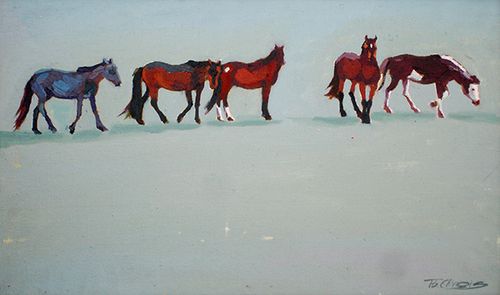
In Grey Horses, Tulgabaatar captures a quiet, powerful moment that is deeply rooted in Mongolian heritage. The painting features a group of horses—rendered in varying shades of grey, silver, and muted charcoal—standing together in a natural landscape.
The composition is horizontal and intimate, with the 30 x 50 cm dimensions creating a “panoramic window” effect. Rather than a wide-angle view of a stampede, the artist chooses a mid-range perspective that focuses on the physical presence and textural detail of the animals.
Artistic Style and Technique
The painting sits at the intersection of several styles, showcasing Tulgabaatar’s technical precision:
Photorealism & Realism: The artist’s brushwork is nearly invisible. Every detail—from the sheen on the horses’ coats to the individual strands of their manes and the moisture in their eyes—is rendered with photographic accuracy.
Landscape & Nature: The backdrop is likely inspired by the Mongolian steppe. The lighting suggests an overcast sky or the soft glow of early morning, which minimizes harsh shadows and allows the subtle tonal variations of the “grey” horses to take center stage.
Figurative Art: While the subjects are animals, the painting is treated with the dignity of a human portrait. There is a clear focus on the musculature, skeletal structure, and the “personality” of each horse.
Emotional Resonance
There is a profound sense of stillness and resilience in this work. In Mongolian culture, the horse is a symbol of spirit and freedom. By painting them in a realistic, non-idealized manner, Tulgabaatar strips away the “myth” and presents them as living, breathing beings shaped by their environment. The choice of a “grey” palette adds a layer of atmospheric serenity, making the scene feel timeless.
About the Artist
Born in 1985 in Ulaanbaatar, Chinggis Tulgabaatar belongs to a generation of Mongolian artists who have mastered Western classical techniques while maintaining a fierce connection to their nomadic roots. His work is celebrated for its ability to transform everyday scenes of Mongolian life into high-fidelity art that feels both modern and ancient.