
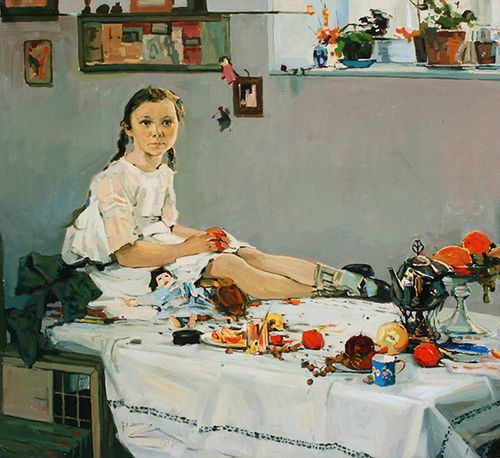
Girl

Chinggis Tulgabaatar , 2007 , Oil On Canvas

This 2007 masterpiece by Chinggis Tulgabaatar is a profound example of how contemporary Mongolian artists blend traditional nomadic identity with the sharp, uncompromising clarity of Photorealism. At 100 x 120 cm, the scale is large enough to pull the viewer into an intimate, almost startling proximity with the subject.

Visual Analysis

1. The Subject: A Study of Texture and Soul The centerpiece of the work is a young Mongolian girl, rendered with such precision that she appears to breathe. Tulgabaatar doesn’t shy away from the reality of life on the steppe; her skin often shows the “kiss of the sun”—the characteristic rosy, wind-burned cheeks common to children in the high-altitude Mongolian climate. Every detail, from the stray fibers of her traditional deel (garment) to the moisture in her eyes, is captured with an obsessive level of detail.

2. The Landscape: The Infinite Background While the figure is the focal point, the Nature and Landscape elements are far from secondary. The background typically features the vast, rolling grasslands or the soft, hazy horizon of the Mongolian countryside. Tulgabaatar often uses a “shallow depth of field” technique (borrowed from photography), where the girl is in sharp focus while the landscape melts into a soft, atmospheric blur. This emphasizes the isolation and the immense scale of the Mongolian wild.

3. Lighting and Color Palette The artist utilizes naturalistic lighting, often mimicking the “golden hour” of the steppe. The palette is a sophisticated mix of:

  • Earth Tones: Ochre, dusty browns, and muted greens of the dry grass.

  • Vibrant Accents: The girl’s clothing often provides a pop of saturated color (reds or deep blues), creating a visual anchor against the neutral landscape.

  • Skin Tones: A complex layering of pinks, tans, and translucent whites to achieve a lifelike glow.

Stylistic Significance: The “New” Realism

Created when the artist was only 22, Girl showcases a technical maturity that helped define his career. Tulgabaatar belongs to a generation of Mongolian artists who moved away from Soviet-era “Socialist Realism” and toward a more personal, Figurative Art that prioritizes individual humanity over political messaging.

By using Photorealism, he forces the viewer to confront the “Girl” not as a generic symbol of Mongolia, but as a specific, living individual with a story.

Note on Scale: The 120cm width ensures that the girl’s face is larger than life-size. This creates a “hyper-present” effect, where the viewer feels a sense of duty to acknowledge the subject’s gaze.

  • Chinggis Tulgabaatar
  • Modern/Minimalist, Photorealism
  • Oil On Canvas
  • CHI72/040
  • 100 x 120cm

Add Your Comment

Mongolian Art Gallery © 2025. All Rights Reserved
Privacy Policy / Terms of Use

This 2007 masterpiece by Chinggis Tulgabaatar is a profound example of how contemporary Mongolian artists blend traditional nomadic identity with the sharp, uncompromising clarity of Photorealism. At 100 x 120 cm, the scale is large enough to pull the viewer into an intimate, almost startling proximity with the subject.

Visual Analysis

1. The Subject: A Study of Texture and Soul The centerpiece of the work is a young Mongolian girl, rendered with such precision that she appears to breathe. Tulgabaatar doesn’t shy away from the reality of life on the steppe; her skin often shows the “kiss of the sun”—the characteristic rosy, wind-burned cheeks common to children in the high-altitude Mongolian climate. Every detail, from the stray fibers of her traditional deel (garment) to the moisture in her eyes, is captured with an obsessive level of detail.

2. The Landscape: The Infinite Background While the figure is the focal point, the Nature and Landscape elements are far from secondary. The background typically features the vast, rolling grasslands or the soft, hazy horizon of the Mongolian countryside. Tulgabaatar often uses a “shallow depth of field” technique (borrowed from photography), where the girl is in sharp focus while the landscape melts into a soft, atmospheric blur. This emphasizes the isolation and the immense scale of the Mongolian wild.

3. Lighting and Color Palette The artist utilizes naturalistic lighting, often mimicking the “golden hour” of the steppe. The palette is a sophisticated mix of:

  • Earth Tones: Ochre, dusty browns, and muted greens of the dry grass.

  • Vibrant Accents: The girl’s clothing often provides a pop of saturated color (reds or deep blues), creating a visual anchor against the neutral landscape.

  • Skin Tones: A complex layering of pinks, tans, and translucent whites to achieve a lifelike glow.

Stylistic Significance: The “New” Realism

Created when the artist was only 22, Girl showcases a technical maturity that helped define his career. Tulgabaatar belongs to a generation of Mongolian artists who moved away from Soviet-era “Socialist Realism” and toward a more personal, Figurative Art that prioritizes individual humanity over political messaging.

By using Photorealism, he forces the viewer to confront the “Girl” not as a generic symbol of Mongolia, but as a specific, living individual with a story.

Note on Scale: The 120cm width ensures that the girl’s face is larger than life-size. This creates a “hyper-present” effect, where the viewer feels a sense of duty to acknowledge the subject’s gaze.