
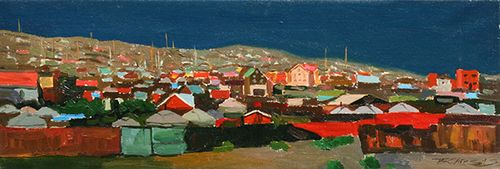
The extreme horizontal dimensions (a 1:3 ratio) force the viewer’s eye to sweep across the canvas, mimicking the way one would view a vast horizon in person. Tulgabaatar positions the viewer at a slight elevation, looking down into a Ger District—the traditional residential areas where felt gers (yurts) and small wooden houses coexist within fenced enclosures known as hashaas.
The composition is characterized by:
Linear Rhythm: The repetitive vertical lines of the wooden fences create a rhythmic, almost musical cadence across the width of the painting.
Juxtaposition: The circular, organic shapes of the white gers contrast sharply with the rigid, rectangular geometry of the wooden fences and makeshift cabins.
Visual Details and Texture
Adhering to the principles of Photorealism, Tulgabaatar renders the textures with clinical precision.
The Gers: The felt coverings of the gers are painted with such detail that one can almost feel the heavy, insulating wool. The orange or red-painted wooden doors provide small, vibrant pops of color against the neutral landscape.
The Fences: The weathered wood of the fences shows individual grain, knots, and the wear of the harsh Mongolian elements. The variation in wood tones—from sun-bleached grey to deep cedar brown—adds a sense of history and lived-in reality to the scene.
The Ground: The earth is depicted as a mix of packed dirt, sparse patches of hardy steppe grass, and the dusty tracks of footpaths and vehicle tires, capturing the tactile “grit” of the district.
Atmosphere and Light
The lighting in the painting is characteristic of the “Land of the Eternal Blue Sky.”
High Contrast: The light is crisp and direct, casting sharp, deep shadows that provide the painting with a three-dimensional, sculptural quality.
Color Palette: The palette is dominated by earthy ochres, dusty browns, and brilliant whites. The sky, often visible as a sliver at the top or reflected in small window panes, is a piercing, clear blue.
Environmental Realism: There is a palpable sense of the dry, thin air of the high-altitude steppe. The lack of atmospheric haze ensures that even the furthest structures in the background remain in sharp focus.
Thematic Significance
While the painting is a “Landscape,” it functions as Figurative Art in a broader sense. Though human figures may be small or absent, their presence is felt everywhere—in the laundry hanging on a line, the smoke rising from a chimney, or the strategic placement of a satellite dish on a ancient-style dwelling.
Tulgabaatar captures a moment of transition: the intersection of centuries-old nomadic tradition (the ger) with modern permanent settlement (the fenced district). It is a portrait of Mongolian identity in the 21st century—resilient, grounded, and expansive.