
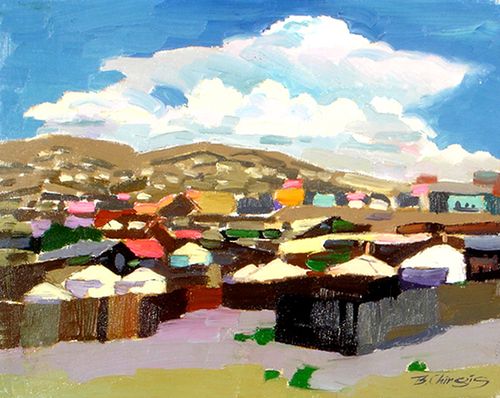
Despite its modest 30 x 40 cm dimensions, the painting captures an expansive sense of atmosphere. It depicts a classic Mongolian “Ger district”—the sprawling residential areas on the periphery of the capital where traditional nomadic dwellings (Gers) stand alongside fixed wooden fences and makeshift structures.
Composition: The perspective is often grounded, placing the viewer within the narrow, winding alleys (khashaa) of the district. The 2007 timeframe is critical; it captures a moment of rapid urban expansion, where the stark white curves of the Gers contrast sharply against the linear, weathered timber of the surrounding fences.
Light and Color: Tulgabaatar utilizes a palette of dusty ochres, muted browns, and the brilliant, high-altitude blue of the Mongolian sky. His use of light is photorealistic, capturing the harsh, direct sun that defines the high-steppe climate, casting deep, sharp shadows that give the composition a sense of stillness and weight.
Texture: The artist demonstrates remarkable skill in rendering different materials. One can almost feel the rough grain of the sun-bleached wood, the heavy felt covering of the Gers, and the dry, packed earth of the pathways.
Style and Context
As an artist born and raised in Ulaanbaatar, Tulgabaatar approaches this subject with an insider’s gaze. While the painting falls under Realism and Photorealism, it transcends mere documentation.
Landscape vs. Figurative: While the primary focus is the landscape, the “human” presence is felt everywhere—in the placement of a satellite dish, a wisp of smoke from a stovepipe, or the specific way a gate is latched. It is a portrait of a community without needing to show a single face.
Cultural Dialogue: The work highlights the tension between Mongolia’s nomadic heritage and its urban reality. By elevating a “Ger district”—often viewed through a lens of poverty or transition—into a subject of high-art realism, Tulgabaatar dignifies the lived experience of thousands of Mongolians.
Note: At the time of this painting (2007), Tulgabaatar was only 22 years old, showcasing a technical maturity in oil handling that would eventually make him a prominent figure in contemporary Mongolian figurative art.