
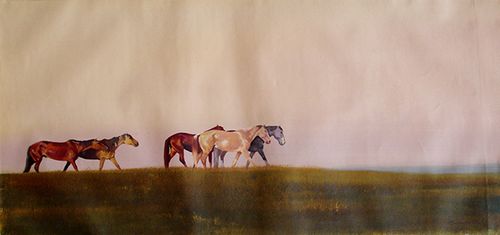
Five Horse is a masterful oil on canvas painting by the renowned Mongolian artist Erdene Dash. Completed in 2007, just two years before the artist’s passing, this piece serves as a sophisticated testament to his rigorous classical training at the Repin Academy of Arts and his deep-seated connection to the Mongolian landscape.
Visual Composition and Subject Matter
The painting is set in a wide, panoramic format (50 x 95 cm), which allows for a sweeping narrative of motion and form. At its core, the work explores the symbiotic relationship between nature and humanity, blending Figurative Art with Landscape Painting.
The Equine Figures: True to the title, five horses are the primary focus. They are rendered with meticulous Realism, showcasing Dash’s ability to capture the powerful musculature, glossy coats, and spirited temperament of the Mongolian horse. Their arrangement across the canvas suggests a rhythmic progression, as if they are moving through a dreamlike, expansive steppe.
The Nude Figures: Integrated seamlessly into the composition are nude human figures. Dash utilizes Nude Figure Composition not for provocation, but to emphasize the raw, organic connection between the human body and the natural world. The skin tones are rendered with a luminous quality, contrasting softly against the earthy tones of the horses and the horizon.
Technique and Style
Drawing from the Russian Academic traditions of the Surikov and Repin institutes, Dash employs a high level of technical precision:
Chiaroscuro & Lighting: The play of light and shadow is used to give the figures a three-dimensional, sculptural quality. The light appears naturalistic, perhaps suggesting the “golden hour” of a Mongolian sunset.
Brushwork: While the figures are handled with smooth, academic refinement, the background landscapes often feature more expressive, textured brushstrokes, providing a sense of atmosphere and depth.
Color Palette: The palette is dominated by sophisticated earth tones—ochres, deep browns, and muted greens—interspersed with the delicate, warm fleshy tones of the figures, creating a harmonious and grounded aesthetic.
Atmosphere and Symbolism
The painting evokes a sense of timelessness. By placing the nude form alongside the horse—a symbol of freedom and survival in Mongolian culture—Dash strips away modern artifice to reach a “primordial” state of being. The work reflects a Nature-Inspired philosophy where the boundaries between the hunter, the herder, the animal, and the land are blurred.