

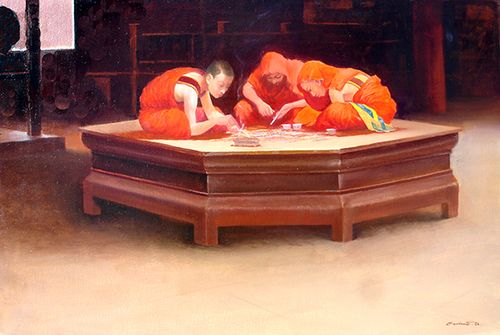
Fasting is a poignant oil-on-canvas masterpiece that exemplifies Erdene Dash’s mastery of the Russian Academic tradition, fused with a profound, soulful connection to the Mongolian landscape. Measuring 40 x 60 cm, the work is a sophisticated study of the human form in dialogue with the natural world.
Composition and Subject Matter
The painting features a nude figure integrated seamlessly into a desolate, yet evocative landscape. Dash utilizes his rigorous training from the Repin Academy to render the anatomy with exquisite precision, yet the figure is not merely an anatomical study. Instead, the body is depicted in a state of vulnerability and quiet strength. The posture suggests a meditative or ascetic repose—aligning with the title Fasting—where the physical self seems to be thinning or yielding to a higher spiritual or elemental state.
The horizontal orientation (40 x 60 cm) allows the artist to emphasize the vastness of the environment. The figure is positioned in a way that creates a rhythmic flow with the contours of the earth, suggesting that the human body and the terrain are made of the same fundamental essence.
Technique and Color Palette
Dash employs Realism not just as a stylistic choice, but as a tool for emotional depth. The brushwork is disciplined yet expressive:
The Flesh Tones: The skin is rendered with subtle glazes and a sophisticated palette of ochres, pale pinks, and cool grays, capturing the way light interacts with the surface of the body under an open sky.
The Landscape: The background reflects the rugged beauty of the Mongolian steppe or high-altitude terrain. The textures of the earth—rendered with visible, confident brushstrokes—contrast with the smoothness of the skin, highlighting the “nude” state as one of raw exposure to nature.
Chiaroscuro: There is a delicate play of light and shadow that defines the musculature and skeletal structure of the figure, emphasizing the “fasting” theme through the subtle prominence of bone and the hollows of the frame.
Atmosphere and Symbolism
The atmosphere of the painting is one of profound solitude and transcendence. By removing the distractions of clothing and modern artifice, Dash strips the subject down to their most primal state.
Nature as Sanctuary: The landscape is not a backdrop but a participant. It suggests a space where the “fasting” is not just a lack of food, but a shedding of the ego and a return to the silence of the earth.
Cultural Synthesis: While the technique is firmly rooted in the St. Petersburg academic style, the soul of the painting is distinctly Mongolian—conveying a sense of endurance, the vastness of the horizon, and the stoic relationship between the individual and the infinite.
In Fasting, Erdene Dash achieves a rare balance between technical rigor and poetic vulnerability, creating a work that feels both timeless and deeply personal.