
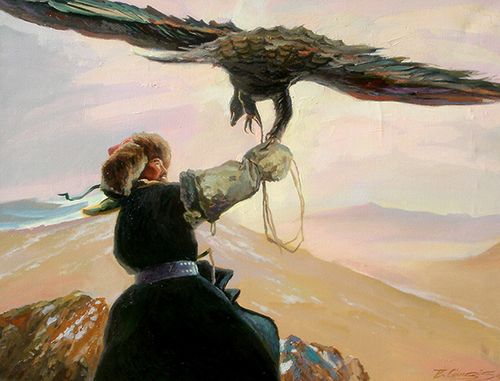
Eagle Hunter

Chinggis Tulgabaatar , 2008 , Oil On Canvas

Eagle Hunter is a compelling oil-on-canvas work measuring 63 x 83 cm. It serves as both a masterful portrait and an expansive landscape, centering on the ancient bond between a hunter and his golden eagle. Set against the rugged backdrop of the Mongolian highlands, the painting is a study in texture, light, and cultural pride.

Subject Matter and Composition

The composition is dominated by a figurative focus on the hunter and his bird, positioned slightly off-center to allow the vastness of the landscape to breathe.

  • The Hunter: A man of middle age, his face is a map of the Mongolian climate—deeply tanned, with fine lines around the eyes suggesting a lifetime spent squinting against the sun and wind. He wears a traditional heavy deel (robe) trimmed with thick, dark fur. His expression is one of quiet intensity and mutual respect for his companion.

  • The Golden Eagle: Perched regally on the hunter’s thick leather gauntlet, the eagle is the secondary protagonist. Its feathers are rendered with such photorealistic detail that one can almost sense the oily sheen and the individual barbs of each plume. Its piercing yellow eye reflects the horizon, matching the alert posture of the hunter.

Style and Technique

Chinggis Tulgabaatar employs a Realist approach that borders on Photorealism, particularly in the treatment of surfaces:

  • Texture: The contrast between the soft, chaotic texture of the fox-fur hat, the coarse weave of the wool robes, and the sharp, metallic curve of the eagle’s beak is rendered with extreme clarity.

  • Lighting: The scene is bathed in the “golden hour” light of a high-altitude afternoon. The sun strikes the figures from the side, creating long, dramatic shadows and highlighting the fine dust particles in the air and the stray tufts of fur on the hunter’s clothing.

Setting and Atmosphere

The Landscape element is not merely a background but a vital part of the narrative.

  • The Horizon: The middle ground gives way to undulating, arid hills that transition into the jagged, snow-dusted peaks of the Altai Mountains in the far distance.

  • Atmospheric Perspective: The colors shift from the warm, saturated ochres and browns of the foreground to the cool, hazy blues and misty greys of the mountains, creating an immense sense of depth and solitude.

Color Palette

The palette is deeply rooted in the earth tones of the steppe:

  • Dominant Hues: Burnt sienna, raw umber, and golden ochre define the earth and the hunter’s attire.

  • Accents: These warm tones are punctuated by the stark white of the mountain snow and the deep, midnight blues of the distant shadows, providing a balanced, naturalistic harmony.

Note on Style: In 2008, at just 23 years old, Tulgabaatar’s ability to capture such technical complexity demonstrated a maturity in figurative art that would eventually make him a prominent voice in modern Mongolian Realism.

  • Chinggis Tulgabaatar
  • Landscape, Mongolian Style
  • Oil On Canvas
  • CHI72/044
  • 63 x 83cm
  • Mongolian Art Gallery

Add Your Comment

Mongolian Art Gallery © 2025. All Rights Reserved
Privacy Policy / Terms of Use

Eagle Hunter is a compelling oil-on-canvas work measuring 63 x 83 cm. It serves as both a masterful portrait and an expansive landscape, centering on the ancient bond between a hunter and his golden eagle. Set against the rugged backdrop of the Mongolian highlands, the painting is a study in texture, light, and cultural pride.

Subject Matter and Composition

The composition is dominated by a figurative focus on the hunter and his bird, positioned slightly off-center to allow the vastness of the landscape to breathe.

  • The Hunter: A man of middle age, his face is a map of the Mongolian climate—deeply tanned, with fine lines around the eyes suggesting a lifetime spent squinting against the sun and wind. He wears a traditional heavy deel (robe) trimmed with thick, dark fur. His expression is one of quiet intensity and mutual respect for his companion.

  • The Golden Eagle: Perched regally on the hunter’s thick leather gauntlet, the eagle is the secondary protagonist. Its feathers are rendered with such photorealistic detail that one can almost sense the oily sheen and the individual barbs of each plume. Its piercing yellow eye reflects the horizon, matching the alert posture of the hunter.

Style and Technique

Chinggis Tulgabaatar employs a Realist approach that borders on Photorealism, particularly in the treatment of surfaces:

  • Texture: The contrast between the soft, chaotic texture of the fox-fur hat, the coarse weave of the wool robes, and the sharp, metallic curve of the eagle’s beak is rendered with extreme clarity.

  • Lighting: The scene is bathed in the “golden hour” light of a high-altitude afternoon. The sun strikes the figures from the side, creating long, dramatic shadows and highlighting the fine dust particles in the air and the stray tufts of fur on the hunter’s clothing.

Setting and Atmosphere

The Landscape element is not merely a background but a vital part of the narrative.

  • The Horizon: The middle ground gives way to undulating, arid hills that transition into the jagged, snow-dusted peaks of the Altai Mountains in the far distance.

  • Atmospheric Perspective: The colors shift from the warm, saturated ochres and browns of the foreground to the cool, hazy blues and misty greys of the mountains, creating an immense sense of depth and solitude.

Color Palette

The palette is deeply rooted in the earth tones of the steppe:

  • Dominant Hues: Burnt sienna, raw umber, and golden ochre define the earth and the hunter’s attire.

  • Accents: These warm tones are punctuated by the stark white of the mountain snow and the deep, midnight blues of the distant shadows, providing a balanced, naturalistic harmony.

Note on Style: In 2008, at just 23 years old, Tulgabaatar’s ability to capture such technical complexity demonstrated a maturity in figurative art that would eventually make him a prominent voice in modern Mongolian Realism.