
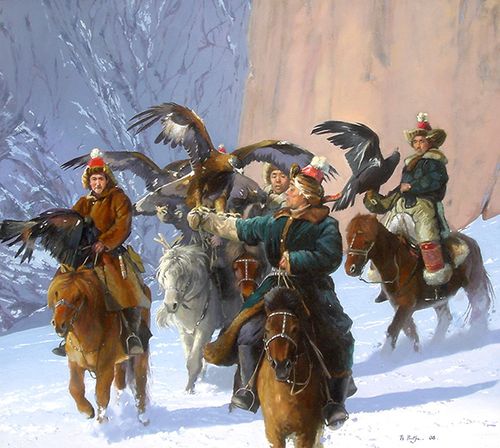
Eagle Hunter 2 is a masterwork of Photorealism that captures the rugged spirit of the Altai Mountains and the ancient tradition of Kazakh falconry. In this 2008 piece, Tseintsogzol utilizes a near-square canvas to create an intimate yet powerful portrait of a hunter and his golden eagle, emphasizing the profound symbiosis between man and bird.
Composition and Style
The painting is characterized by its meticulous attention to detail, a hallmark of Tseintsogzol’s style. The artist employs a high-contrast palette, likely focusing on the rich, organic textures of the hunter’s traditional attire—heavy furs, embroidered silks, and leather—against the sharp, predatory features of the eagle.
Realism & Texture: Every feather of the eagle and every crease in the hunter’s weathered face is rendered with anatomical precision. The light likely catches the glint in the bird’s eye and the coarse texture of the sheepskin coat, making the scene feel tangible.
Atmosphere: While the subjects are rendered with photographic clarity, the background often serves as a soft-focus vista of the Mongolian steppe or snow-capped peaks, ensuring the viewer’s focus remains entirely on the central partnership.
Thematic Significance
Batjargal Tseintsogzol was renowned for documenting the nomadic heritage of Mongolia. Eagle Hunter 2 is more than a technical exercise in oil painting; it is a cultural preservation. It depicts the Burkitshi (eagle hunters) not as historical relics, but as living embodiments of endurance and heritage. The 100 x 110 cm scale allows the subjects to appear almost life-sized, inviting the viewer into the biting cold and the quiet dignity of the Central Asian highlands.
Note on the Artist: Born in Ulaanbaatar, Tseintsogzol’s work is celebrated for bridging the gap between traditional Mongolian subjects and contemporary Western realism. His untimely passing in 2020 left a significant void in the Mongolian contemporary art scene.