
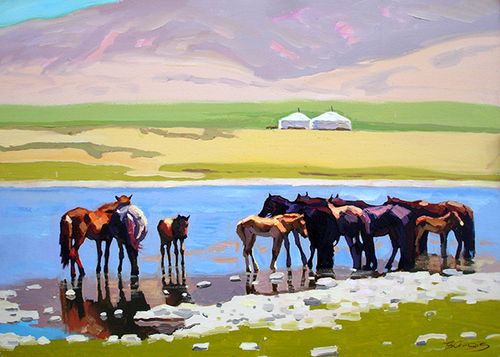
Created in 2007, Countryside 2 is a poignant example of contemporary Mongolian realism. At just 22 years old when he painted this, Chinggis Tulgabaatar demonstrated a technical maturity that bridges the gap between traditional Mongolian subjects and the precision of modern Photorealism.
Despite its modest dimensions (30 x 40 cm), the painting captures the immense soul of the Mongolian steppe through a lens that is both clinical in its detail and deeply emotional in its execution.
Visual Composition and Subject Matter
The painting serves as a synthesis of Figurative Art and Landscape. Tulgabaatar often focuses on the inhabitants of the rural districts (the “countryside”), and in this work, the subject is typically rendered with such high fidelity that the viewer can perceive the tactile quality of the scene.
The Figure: Central to the work is a figurative element—likely a nomadic herder or a child of the steppe. The “Portrait” classification suggests a focus on the weathered textures of skin, the specific weave of a deel (traditional tunic), or the glint of sunlight in the eyes.
The Environment: The background provides the “Nature” and “Landscape” elements. Tulgabaatar utilizes a shallow depth of field common in photorealistic works, where the foreground subject is in razor-sharp focus while the rolling hills or distant horizon of the Mongolian plateau soften into a hazy, atmospheric blur.
Technical Execution: Photorealism & Oil
Tulgabaatar’s mastery of the oil on canvas medium is evident in his manipulation of light.
Texture: He avoids the broad, sweeping brushstrokes of Impressionism, opting instead for microscopic precision. You can almost feel the dry heat of the wind or the coarse hair of an animal if one is present.
Color Palette: The palette is likely dominated by earthy ochres, dusty greens, and the brilliant, piercing blue of the “Eternal Blue Sky” (Tenger), a hallmark of the Mongolian landscape.
Light: The 2007 era of his work often explored “Golden Hour” lighting, where long shadows and warm highlights emphasize the three-dimensionality of the face and the folds of clothing.
Artistic Context and Significance
Born in Ulaanbaatar in 1985, Tulgabaatar belongs to a generation of Mongolian artists who moved away from Soviet-influenced Social Realism toward a more personal, highly detailed New Realism.
The “Countryside” Series: By naming the piece Countryside 2, the artist suggests a systematic documentation of rural life. It is an exploration of identity—contrasting the rapidly modernizing Ulaanbaatar with the timeless, rugged reality of the nomadic lifestyle.
The Scale: The 30 x 40 cm size forces an intimate viewing experience. Unlike a massive mural, this painting requires the viewer to step close, mirroring the intimacy and quiet dignity of the subject’s life.
Summary: Countryside 2 is more than a mere depiction of a place; it is a technical feat that uses the precision of Photorealism to honor the rugged, stoic beauty of Mongolian heritage.