
Chaos

Erdene Dash , 2004 , Oil On Canvas

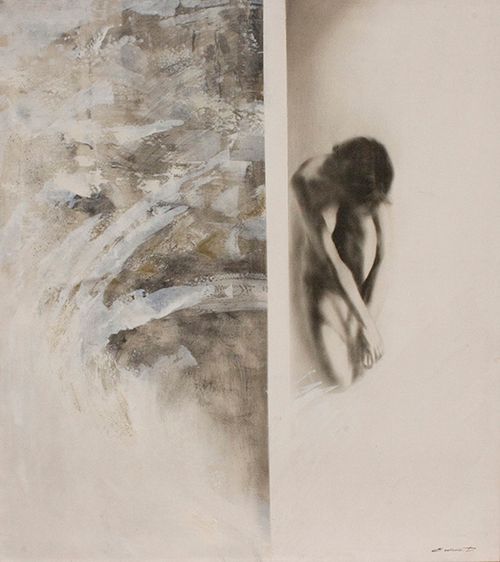
In Chaos, Erdene Dash utilizes the rigorous academic training he received at the Repin Academy of Arts to create a masterwork that merges the raw power of the Mongolian landscape with the vulnerability of the human form. Despite the title, the composition is a sophisticated exercise in Realism and Figurative Art, where “chaos” refers not to a lack of order, but to the overwhelming, unbridled energy of nature.

The Central Figure

At the heart of the 100 x 95 cm canvas lies a nude figure, rendered with meticulous anatomical precision. The skin tones are a complex palette of ochres, pale pinks, and cool shadows, reflecting the ambient light of an outdoor setting. The figure is not merely “placed” in the scene; the limbs are intertwined with the earth, suggesting a symbiotic—perhaps even struggling—relationship with the environment. The pose is dynamic and asymmetrical, embodying a sense of tension and movement that anchors the “chaos” surrounding it.

Landscape and Atmosphere

The background is a sweeping testament to Dash’s roots in Ulaanbaatar and his mastery of Landscape Painting. He depicts a rugged, natural terrain where the elements seem to be in a state of flux.

  • The Earth: The foreground features fractured rocks and swirling organic matter, painted with thick, confident brushstrokes that provide a tactile, visceral quality.

  • The Sky: The atmosphere is heavy and brooding, utilizing a dramatic chiaroscuro effect. Turbulent clouds are rendered in deep greys and muted violets, contrasted by sudden flashes of light that illuminate the figure.

Technique and Style

Dash employs a high-realism technique characterized by:

  • Layering: Traditional oil glazing techniques that create depth in the flesh tones.

  • Texture: A contrast between the smooth, blended skin of the nude figure and the impasto, rugged textures of the Mongolian wilderness.

  • Composition: A tight, almost square format that creates a sense of monumentalism, making the scene feel larger than its physical dimensions.
  • Erdene Dash
  • Minimalist, Mongolian Style
  • Oil On Canvas
  • ERE24/026
  • 100 x 95cm
  • Mongolian Art Gallery

Add Your Comment

Mongolian Art Gallery © 2025. All Rights Reserved
Privacy Policy / Terms of Use

In Chaos, Erdene Dash utilizes the rigorous academic training he received at the Repin Academy of Arts to create a masterwork that merges the raw power of the Mongolian landscape with the vulnerability of the human form. Despite the title, the composition is a sophisticated exercise in Realism and Figurative Art, where “chaos” refers not to a lack of order, but to the overwhelming, unbridled energy of nature.

The Central Figure

At the heart of the 100 x 95 cm canvas lies a nude figure, rendered with meticulous anatomical precision. The skin tones are a complex palette of ochres, pale pinks, and cool shadows, reflecting the ambient light of an outdoor setting. The figure is not merely “placed” in the scene; the limbs are intertwined with the earth, suggesting a symbiotic—perhaps even struggling—relationship with the environment. The pose is dynamic and asymmetrical, embodying a sense of tension and movement that anchors the “chaos” surrounding it.

Landscape and Atmosphere

The background is a sweeping testament to Dash’s roots in Ulaanbaatar and his mastery of Landscape Painting. He depicts a rugged, natural terrain where the elements seem to be in a state of flux.

  • The Earth: The foreground features fractured rocks and swirling organic matter, painted with thick, confident brushstrokes that provide a tactile, visceral quality.

  • The Sky: The atmosphere is heavy and brooding, utilizing a dramatic chiaroscuro effect. Turbulent clouds are rendered in deep greys and muted violets, contrasted by sudden flashes of light that illuminate the figure.

Technique and Style

Dash employs a high-realism technique characterized by:

  • Layering: Traditional oil glazing techniques that create depth in the flesh tones.

  • Texture: A contrast between the smooth, blended skin of the nude figure and the impasto, rugged textures of the Mongolian wilderness.

  • Composition: A tight, almost square format that creates a sense of monumentalism, making the scene feel larger than its physical dimensions.