
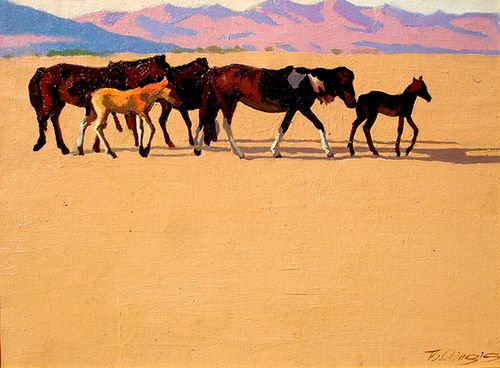
Camels of Gobi (2007) is a masterful early work by the Mongolian contemporary artist Chinggis Tulgabaatar. Created when the artist was only 22 years old, the painting serves as a testament to his technical precision and his deep-rooted connection to the Mongolian landscape.
Despite its modest dimensions (25 x 30 cm), the piece carries the weight and “bigness” of the desert it portrays, blending the meticulousness of Photorealism with the soulful depth of Figurative Art.
Visual Composition and Subject
The painting captures a group of Bactrian (two-humped) camels against the vast, unforgiving expanse of the Gobi Desert. Tulgabaatar treats the camels not merely as part of the scenery, but as subjects of a portrait.
The Focus: The artist highlights the camels’ unique physiology—their thick, shaggy winter coats, the rugged texture of their humps, and their stoic, almost contemplative facial expressions.
The Perspective: By choosing a 25 x 30 cm canvas, Tulgabaatar creates an intimate viewing experience. The viewer is forced to lean in, mirroring the way a traveler in the desert must focus on the immediate details of survival amidst a vast horizon.
Style and Technique
Tulgabaatar’s work is defined by a rigorous adherence to Realism, bordering on the clinical accuracy of Photorealism.
Texture: The oil medium is used to extraordinary effect. You can almost feel the coarseness of the camel hair and the fine, powdery silt of the Gobi sand. Every strand of wool and every wrinkle in the camels’ skin is rendered with surgical precision.
Lighting: The painting likely employs the harsh, high-contrast light characteristic of the Mongolian plateau. This light creates deep shadows in the folds of the animals’ coats and bright highlights that give the figures a three-dimensional, sculptural quality.
Color Palette: The palette is a sophisticated study in earth tones—mustard yellows, dusty ochres, deep umbers, and burnt siennas. These tones are punctuated by the pale, hazy blues or washed-out greys of the distant desert sky.
Cultural Significance
Born in Ulaanbaatar in 1985, Tulgabaatar represents a generation of Mongolian artists who use Western academic realism to preserve and celebrate traditional nomadic life.
In Camels of Gobi, the camel is more than an animal; it is a symbol of resilience and endurance. By applying such a high level of detail to these creatures, the artist elevates them to a status of nobility, reflecting their vital importance to the Mongolian heritage and the survival of the nomadic people.
Artistic Note: The “Figurative Art” tag here is crucial. While the subject is an animal, the artist applies the same level of psychological depth to the camels as one would to a human subject, capturing a sense of “personality” and ancient wisdom.