

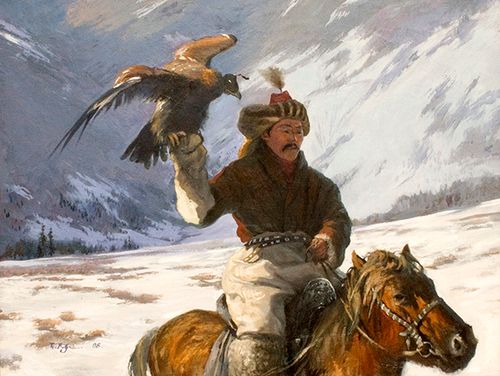
Batjargal Tseintsogzol’s “Eagle Hunter” (2008) is a masterful exercise in contemporary Mongolian Photorealism. Measuring 62 x 82cm, this oil-on-canvas work serves as both a cultural document and a profound psychological portrait, capturing the stoic dignity of the Kazakh eagle hunters (Burkitshi) of the Altai Mountains.
Composition and Subject
The painting centers on a solitary hunter and his golden eagle, framed against a vast, minimalist landscape. Tseintsogzol utilizes a tight, intimate composition that bridges the gap between the viewer and the subject. The hunter’s weathered face, etched with the harshness of the Mongolian steppe, reflects a lifetime of endurance and a deep-seated connection to the natural world.
The eagle, perched with regal stillness, is rendered with such precision that every barb of its feathers and the glassy sharpness of its eye feel tangible. This duality—the ruggedness of the man and the wild elegance of the bird—highlights the symbiotic relationship central to this ancient nomadic tradition.
Style and Technique
As a leading figure in Mongolian Realism, Tseintsogzol’s technique in this piece is remarkable:
Photorealistic Precision: The artist treats textures with forensic detail. From the coarse fur of the hunter’s traditional deeel (robe) and fox-skin hat to the cracked skin of his hands, the tactile quality of the materials is hyper-apparent.
Atmospheric Perspective: While the foreground is sharp and detailed, the background dissolves into soft, muted tones of the Eurasian steppe. This use of “bokeh-like” depth of field ensures the viewer’s focus remains entirely on the bond between man and predator.
Lighting: The light is naturalistic and directional, suggesting the low, golden sun of a high-altitude afternoon. This creates deep shadows that define the musculature of the eagle and the contours of the hunter’s face, adding a sense of dramatic gravity.
Cultural Significance
Born in Ulaanbaatar in 1966, Tseintsogzol belonged to a generation of Mongolian artists who sought to reconcile traditional nomadic identities with modern technical excellence. “Eagle Hunter” is not merely a “scenic” painting; it is a preservation of heritage. By placing the subject within the context of Nature, the artist emphasizes that the hunter is not a master of the environment, but a fundamental part of its ecosystem.