
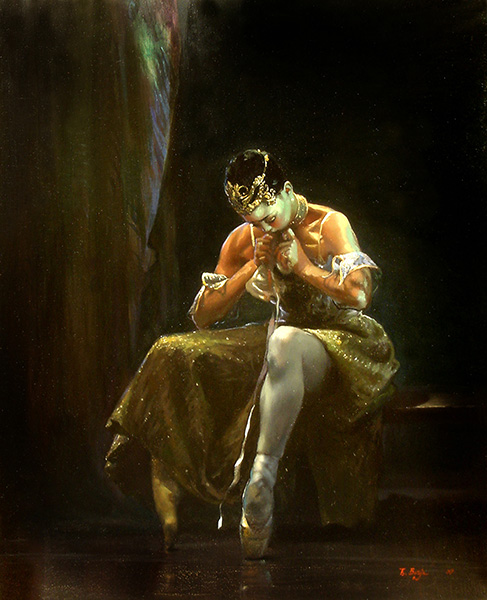
Ballerino

Batjargal Tseintsogzol , 2008 , Oil On Canvas

Ballerino is a compelling testament to Batjargal Tseintsogzol’s mastery of photorealism and his deep-seated appreciation for the quiet intensity of the human form. Painted in 2008, this oil-on-canvas work measures 72 x 61 cm—a scale that invites an intimate, one-on-one dialogue between the viewer and the subject.

Visual Composition & Style

The painting captures a male dancer (a ballerino) in a moment of profound stillness or preparation. True to Tseintsogzol’s reputation for realism, every detail is rendered with clinical precision.

  • The Play of Light: The artist utilizes a dramatic, almost Caravaggio-esque light source that carves the subject out of a muted or dark background. This highlights the anatomical accuracy of the dancer’s musculature, emphasizing the physical toll and disciplined strength required by the craft.

  • Texture and Materiality: Through meticulous oil layering, Tseintsogzol achieves a lifelike rendering of skin, the slight sheen of perspiration, and the specific tension in the dancer’s pose.

  • Atmosphere: While categorized under photorealism, the work transcends mere imitation of a photograph. There is an atmospheric weight to the piece—a sense of “Mongolian Realism” that often blends grit with grace.

Cultural and Artistic Context

Born in Ulaanbaatar, Tseintsogzol was a pivotal figure in contemporary Mongolian art. Ballerino reflects a bridge between traditional academic training and a modern, global aesthetic.

  • Nature & Human Nature: Although the artist is often associated with nature and landscapes, Ballerino treats the human body as a natural landscape in itself, exploring the “nature” of discipline and the internal landscape of a performer.

  • Legacy: Created during the prime of his career, this piece exemplifies why Tseintsogzol remained a respected figure until his passing in 2020. It avoids the flamboyance often associated with dance, opting instead for a grounded, dignified portrayal of the artist behind the performance.
  • Batjargal Tseintsogzol
  • Mongolian Style, Photorealism
  • Oil On Canvas
  • BTJ8/049
  • 72 x 61cm

Add Your Comment

Mongolian Art Gallery © 2025. All Rights Reserved
Privacy Policy / Terms of Use

Ballerino is a compelling testament to Batjargal Tseintsogzol’s mastery of photorealism and his deep-seated appreciation for the quiet intensity of the human form. Painted in 2008, this oil-on-canvas work measures 72 x 61 cm—a scale that invites an intimate, one-on-one dialogue between the viewer and the subject.

Visual Composition & Style

The painting captures a male dancer (a ballerino) in a moment of profound stillness or preparation. True to Tseintsogzol’s reputation for realism, every detail is rendered with clinical precision.

  • The Play of Light: The artist utilizes a dramatic, almost Caravaggio-esque light source that carves the subject out of a muted or dark background. This highlights the anatomical accuracy of the dancer’s musculature, emphasizing the physical toll and disciplined strength required by the craft.

  • Texture and Materiality: Through meticulous oil layering, Tseintsogzol achieves a lifelike rendering of skin, the slight sheen of perspiration, and the specific tension in the dancer’s pose.

  • Atmosphere: While categorized under photorealism, the work transcends mere imitation of a photograph. There is an atmospheric weight to the piece—a sense of “Mongolian Realism” that often blends grit with grace.

Cultural and Artistic Context

Born in Ulaanbaatar, Tseintsogzol was a pivotal figure in contemporary Mongolian art. Ballerino reflects a bridge between traditional academic training and a modern, global aesthetic.

  • Nature & Human Nature: Although the artist is often associated with nature and landscapes, Ballerino treats the human body as a natural landscape in itself, exploring the “nature” of discipline and the internal landscape of a performer.

  • Legacy: Created during the prime of his career, this piece exemplifies why Tseintsogzol remained a respected figure until his passing in 2020. It avoids the flamboyance often associated with dance, opting instead for a grounded, dignified portrayal of the artist behind the performance.