
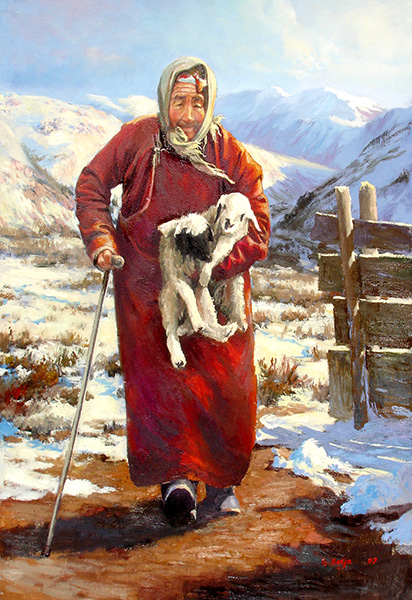
Helping Hand is a poignant masterclass in photorealism and emotional storytelling. Painted in 2007, this oil-on-canvas work exemplifies the late Mongolian artist Batjargal Tseintsogzol’s ability to find profound narrative depth in the quiet, rugged realities of nomadic life.
Visual Composition and Style
Standing at 60 x 45 cm, the painting utilizes a vertical orientation to focus the viewer’s attention on the intimate connection between its subjects. Tseintsogzol employs a high-fidelity realist style, where every texture—from the weathered skin of the hands to the coarse wool of animal hair—is rendered with meticulous detail.
The color palette is grounded in the earthy, muted tones of the Mongolian steppe: deep browns, weathered grays, and soft ochres. This choice reinforces the artist’s association with Nature and Realism, grounding the scene in a specific, tangible environment.
Key Elements of the Narrative
The power of the piece lies in its titular “helping hand.” Tseintsogzol often focused on the interdependence between humans and the natural world. In this work, the viewer likely sees:
The Contrast of Textures: The juxtaposition of human skin against the raw elements of nature (be it livestock or landscape) highlights the resilience required of those living in Ulaanbaatar’s surrounding rural regions.
The Theme of Support: True to its name, the painting captures a moment of physical or symbolic assistance. It celebrates the communal spirit and the “unspoken pact” of survival in harsh climates.
Light and Shadow: The artist uses a gentle, naturalistic light source that mimics the vast, open skies of Mongolia, giving the subjects a three-dimensional weight and a sense of dignity.
“Tseintsogzol’s work isn’t just about ‘looking like a photo’; it’s about capturing the soul of the Mongolian spirit through the precision of the eye.”
About the Artist
Batjargal Tseintsogzol (1966–2020) was a significant figure in contemporary Mongolian art. Born in Ulaanbaatar, his work bridged the gap between traditional Mongolian themes and modern Western photorealistic techniques. His legacy is defined by a deep respect for his heritage and an extraordinary technical ability to capture the fleeting moments of everyday life with monumental importance.