
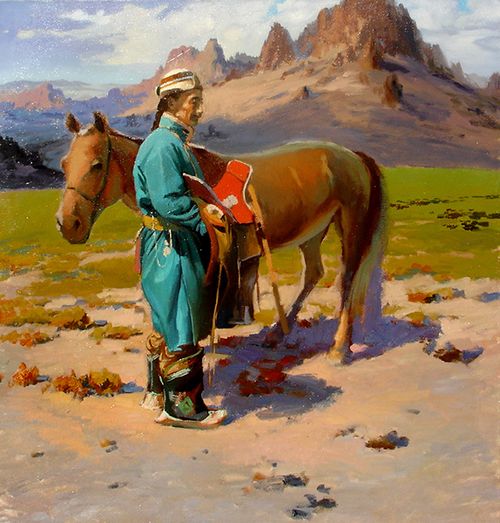
Horseman is a compelling testament to the late Mongolian artist Batjargal Tseintsogzol’s mastery of Photorealism and his deep-seated connection to the nomadic heritage of his homeland. Painted in 2007, this work captures a moment of quiet intensity, bridging the gap between the rugged reality of the Mongolian steppe and the timeless bond between man and beast.
Composition and Style
Tseintsogzol utilizes a tight, focused composition that emphasizes the physical presence of the subjects. The 65 x 75 cm format allows for an intimate look at the textures that define the scene:
The Subject: The horseman is depicted with a weathered dignity. His attire, likely traditional Mongolian del, is rendered with meticulous detail, showing the weight and fold of the fabric.
The Equine Form: True to the Realism style, the horse is not merely a background element but a co-protagonist. The artist’s attention to the sheen of the coat, the musculature, and the intelligent gaze of the animal highlights the essential role horses play in Mongolian culture.
Light and Atmosphere: The painting often features the harsh, clear light characteristic of the high-altitude Mongolian plateau. Tseintsogzol uses this light to create sharp contrasts and deep shadows, giving the figures a three-dimensional, sculptural quality.
Thematic Depth
Beyond its technical brilliance, Horseman explores the theme of Nature as an inseparable part of human identity. Tseintsogzol does not romanticize the landscape into a generic backdrop; instead, he presents it as a living environment that shapes the character of those who traverse it.
His background in Ulaanbaatar and his life spent witnessing the transition of Mongolia into the 21st century added a layer of preservation to his work. Through his Photorealistic lens, he captures a way of life that is both ancient and enduring.
Artist Legacy
Batjargal Tseintsogzol was celebrated for his ability to translate the vastness of Mongolia into the confined space of a canvas without losing its soul. Horseman remains a significant example of his mid-career excellence, showcasing why he is considered a pivotal figure in modern Mongolian Realism.
Note: The precision of the brushwork in this piece is so refined that from a distance, it often mimics the clarity of a high-resolution photograph, a hallmark of Tseintsogzol’s contribution to the Photorealist movement.